

Introduction: A City That Looks Beautiful Until You Start Looking Closely
A trip to Gdansk in Poland can begin like a postcard.
You walk toward the Motława River and see the famous medieval crane, colourful façades, narrow streets, boats moving slowly across the water and the tall brick silhouette of St. Mary's Basilica rising behind the rooftops.
It is beautiful.
But Gdansk becomes much more interesting when you stop treating it as a beautiful European old town.
Look a little closer.
The elegant waterfront hides centuries of maritime trade. The decorative buildings carry memories of a city that has changed hands and identities. The shipyards nearby are inseparable from the birth of the Solidarity movement. And just beyond the centre lies Westerplatte, a place associated with the opening days of the Second World War.
Then there is the Baltic Sea.
Its presence is subtle in the city centre but unmistakable in the wind, the architecture, the food and the character of the people.
For a photographer, this makes Gdansk particularly rewarding. The city offers architecture, water, reflections, people, industrial landscapes, beaches, historic details and changing northern light within a relatively compact area.
Gdansk is also a wonderful starting point for exploring the wider Tri-City region of Gdansk, Sopot and Gdynia.
And unlike some of the more heavily visited cities of Poland, Gdansk has a personality that feels distinctly its own.
Why Take a Trip to Gdansk in Poland?
Gdansk is one of those destinations where several different journeys overlap.
You can come for architecture and unexpectedly find yourself thinking about democracy.
You can come for World War II history and end the afternoon photographing ships.
You can come looking for amber jewellery and discover an old maritime trading city.
You can come for the historic centre and eventually realise that the most fascinating photographs are often outside it.
That variety is the real attraction.

What makes Gdansk different?
A remarkable historic waterfront
Strong maritime heritage
Centuries-old amber traditions
The birthplace of the Solidarity movement
Major World War II sites
A fascinating post-industrial landscape
Easy access to Baltic beaches
Excellent connections to Sopot and Gdynia
Distinctive architecture and street details
Strong photography opportunities throughout the day
The city is also an excellent destination for travellers interested in the wider cities of Poland. Warsaw tells a story of reconstruction and modern Poland; Krakow carries a different medieval and royal atmosphere; Wroclaw has its own architectural personality.
Gdansk feels maritime.
You sense it everywhere.

A Trip to Gdansk in Poland Is Really a Journey Through Layers of History
Gdansk's history is complicated, and that is precisely what makes it fascinating.
The city has existed for centuries at the intersection of Polish, German, Baltic and broader European influences. It became an important port and trading centre, and its prosperity was connected to the sea and to the movement of goods across northern Europe.
Amber became particularly important.
The Baltic region has long been associated with amber, and Gdansk developed a deep connection with the material. Even today, amber shops and jewellery are part of the city's visual identity.
But Gdansk's modern history is perhaps even more consequential.
In 1980, workers at the Gdansk Shipyard went on strike. The movement became associated with Solidarity, or Solidarność, led by Lech Wałęsa. The movement eventually became one of the defining forces behind the collapse of communist rule in Central and Eastern Europe.
The European Solidarity Centre tells this story through exhibitions, photographs, documents and personal accounts. Its permanent exhibition includes the famous 21 demands of the striking workers, which are included in UNESCO's Memory of the World Register.
This is an important point about travelling in Gdansk:
History here isn't confined to a museum.
It is embedded in streets, gates, shipyard cranes and ordinary buildings.

Exploring the Historic Centre of Gdansk
Start early.
Not because you need to rush, but because Gdansk's historic centre changes character dramatically before the crowds arrive.
The area around Długa Street and Długi Targ is where many visitors begin. The architecture is spectacular, but instead of simply photographing the façades straight on, spend time looking for relationships.
A doorway.
A reflection.
A person walking beneath an ornate façade.
A bicycle against an old wall.
A tram appearing at the end of a street.
These small interactions make better travel photographs than a catalogue of monuments.
Długi Targ and Neptune
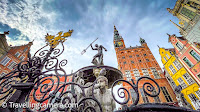
The Neptune Fountain is one of Gdansk's most recognisable landmarks.
The traditional story connects Neptune with the city's maritime identity. There is also a famous local legend about the creation of Goldwasser, the city's historic herbal liqueur, involving the fountain and a rather unexpected interaction with coins.
Whether you are interested in the legend or not, Neptune is worth seeing early in the morning.
By mid-morning, the area becomes much busier.
For photography, stand back rather than immediately reaching for a wide-angle lens. Compressing the perspective with a moderate telephoto lens can isolate Neptune against the surrounding architecture.

Mariacka Street: Where Gdansk Becomes Almost Cinematic
If you photograph only one street in Gdansk, make time for Mariacka Street.
It is famous for its stone terraces, decorative façades, amber shops and distinctive architectural details.
But there is another reason photographers love it.
The street has texture.
Look down.
Look up.
Look sideways.
The gargoyles, drains, carved details and amber displays create layers that are easily missed if you simply walk through.
The best time to photograph Mariacka Street is early morning when the light arrives at a lower angle and the street is relatively quiet.
On an overcast day, don't put your camera away.
Soft Baltic light can be perfect here.
It reduces the contrast between bright façades and darker doorways and allows architectural details to hold their texture.

The Motława Waterfront: Gdansk's Most Photogenic Scene
The waterfront is probably the image most associated with Gdansk.
The medieval Crane, known as Żuraw, dominates the riverfront.
This was not merely decorative architecture. The crane was a working piece of port infrastructure, used to load and unload cargo and handle ship-related operations.
Today, the scene is much calmer.
Boats pass along the river. Restaurants line the waterfront. People sit outside with coffee. Tourists photograph the Crane from the opposite side.
For a photographer, the waterfront is best treated as a changing light laboratory.
Morning
Soft light and fewer people.
Late afternoon
Longer shadows bring out architectural relief.
Blue hour
The buildings begin to glow while the sky retains colour.
This is one of the best moments to photograph Gdansk.
Don't leave immediately after sunset.
Wait.
The few minutes after sunset can produce a deep blue sky against warm artificial light.

The Gdansk Shipyard: Where Beauty Meets Industrial History
This is where the city changes.
Walk away from the polished historic centre toward the shipyard and the visual language becomes different.
Brick gives way to steel.
Decorative façades give way to industrial structures.
Tourist boats are replaced by working infrastructure.
And then the historical significance catches up with you.
The Gdansk Shipyard is inseparable from Solidarity. The European Solidarity Centre describes the shipyard as a place where more than 150 years of industrial history intersected with political, social and cultural history.
The shipyard area is particularly interesting for photographers because it offers something that the historic centre cannot:
scale.
Huge industrial structures create opportunities for minimalist compositions, silhouettes and environmental portraits.
Try photographing the cranes against a pale sky.
Or place a person in the foreground to show scale.
The area around the European Solidarity Centre also provides excellent opportunities for documentary-style photography.

European Solidarity Centre: Understanding the City Beyond Its Pretty Streets
Spend time here before wandering through the shipyard.
The permanent exhibition follows the story of Solidarity and its role in Poland's struggle against communist rule. It is not simply a collection of political documents; it brings the movement down to the level of workers, families, protests and everyday life.
One of the most striking aspects is how the story connects ordinary people with enormous historical consequences.
That changes how you see Gdansk afterwards.
A shipyard gate isn't simply a gate anymore.
A photograph of workers isn't simply a historical image.
A street isn't simply a street.
The city becomes a document.
The Museum of the Second World War
Gdansk is also one of the most important places in Europe for understanding the origins and consequences of the Second World War.
The Museum of the Second World War is located close to the historic centre, near the Motława River.
Its main exhibition is more than 6,000 square metres and lies 14 metres underground. It contains around 3,000 objects and hundreds of multimedia stations.
Give it several hours.
This is not an attraction to squeeze between lunch and a walking tour.
The museum deals with the war through the experiences of civilians, soldiers, victims and societies rather than presenting the conflict merely as a sequence of military events.
For photographers, there is an important lesson here too.
Not every story needs to be photographed.
Sometimes the most respectful response to a place is to put the camera away.

Westerplatte: Standing Where the War Began
A short journey from central Gdansk takes you to Westerplatte.
This peninsula is widely remembered as the site associated with the opening of World War II in September 1939, when Polish defenders resisted the German attack.
Today, the landscape contains ruins, trees, memorials and traces of the former military installation.
It is quieter than the centre.
And that quietness matters.
The Westerplatte Museum project is focused on preserving the authenticity of the battlefield and documenting the Polish defence of the peninsula. Archaeological investigations have uncovered tens of thousands of relics, including the remains of soldiers who were later identified and reburied.
Walk slowly.
Read the information panels.
Look at the trees and broken structures.
The landscape does much of the storytelling.

Oliwa: A Different Side of Gdansk
If the historic centre feels busy, head to Oliwa.
The district has a much quieter residential character, with old houses, greenery and the impressive Oliwa Cathedral.
Oliwa Park is especially pleasant for a slower afternoon.
This is one of those places where you can stop thinking about your itinerary.
Walk.
Sit.
Photograph.
Observe.
Local residents exercising, walking dogs or meeting friends provide a much more ordinary view of Gdansk.
And ordinary is often what makes a photograph memorable.

Góra Gradowa: A View That Many Visitors Miss
For a broader view of Gdansk, consider Góra Gradowa.
The elevated viewpoint provides a different perspective over the city and the shipyard landscape.
Local photographers also recommend it as a useful viewpoint, particularly for seeing the city beyond the classic waterfront compositions.
For a travel photographer, this is valuable because the photograph tells a larger story.
You can include:
Historic rooftops
Modern buildings
Shipyard cranes
Churches
Industrial structures
All in one frame.
Go around sunset or during the blue hour.

Hidden Gdansk: Places to Explore Beyond the Obvious
One of the biggest mistakes is spending the entire trip between Długa Street and the waterfront.
Gdansk rewards wandering.
Lower Town
The Lower Town offers a quieter architectural experience and fewer crowds than the central tourist streets.
Wrzeszcz
Wrzeszcz has a more lived-in atmosphere, with cafés, shops, older residential architecture and everyday city life.
It is a good neighbourhood for street photography because you are less likely to photograph the same scenes as every visitor.
Shipyard edges
The post-industrial areas around the shipyard can be visually fascinating, particularly for photographers interested in architecture and documentary work.
Sobieszewo Island
For nature, beaches and a different relationship with the Baltic landscape, consider Sobieszewo Island.
It feels far removed from the tourist centre.

Best Photography Spots in Gdansk
| Location | Best Time | What to Photograph |
|---|---|---|
| Motława waterfront | Blue hour | Crane, reflections, façades |
| Mariacka Street | Early morning | Architecture, details, people |
| Długi Targ | Early morning | Historic façades and street scenes |
| Gdansk Shipyard | Late afternoon | Cranes, industry, silhouettes |
| European Solidarity Centre | Morning | Architecture and documentary details |
| Góra Gradowa | Sunset | City panorama |
| Oliwa Park | Morning/evening | Nature, architecture, people |
| Westerplatte | Morning | Ruins, landscape, memorials |
| Brzeźno Beach | Sunrise/sunset | Baltic Sea and silhouettes |
| Sopot | Sunrise | Pier, sea and coastal atmosphere |

Photography Tips for a Trip to Gdansk in Poland
Gdansk is a city where light can completely change the photograph.
1. Photograph before breakfast
This may be the single best travel-photography decision you make.
The historic centre becomes dramatically quieter in the early morning.
2. Don't fear cloudy weather
Northern European overcast skies can create beautiful, soft light.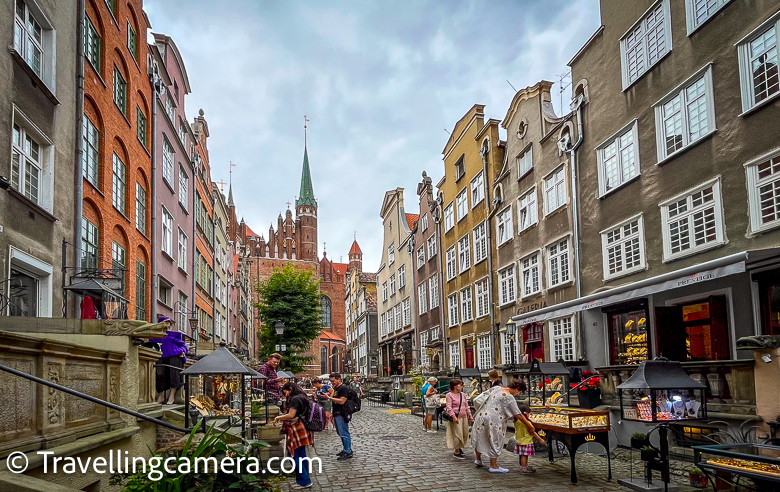
Use them for architecture, portraits and details.
3. Carry a telephoto lens
A 70–200mm-type range is useful for isolating architectural details and compressing the waterfront.
4. Look for reflections
After rain, the polished stone streets around the historic centre can become natural mirrors.
5. Photograph the city at blue hour
Gdansk's waterfront is particularly effective after sunset when warm building lights contrast with the cool evening sky.
6. Shoot vertically
Many of the historic streets are narrow and tall.
Vertical compositions can better capture façades from street level.
7. Photograph people respectfully
If making identifiable portraits, ask permission.
A simple smile and gesture toward your camera often works across language barriers.

What to Eat in Gdansk
Food in Gdansk is another way to understand the city's relationship with the Baltic and northern Poland.
Start with Polish classics.
Try:
Pierogi
Żurek
Bigos
Potato-based dishes
Fish from the Baltic region
Smoked fish
Local pastries
Regional soups
And then there is Goldwasser.
Gdansk's official city information highlights the liqueur's roots in a 16th-century tradition. It is strongly associated with the city's culinary heritage.
But don't turn every meal into a search for a "traditional restaurant."
Sometimes a simple local lunch gives you a better glimpse of everyday Poland.
Milk bars can also be an inexpensive way to experience traditional Polish food. Local residents frequently recommend them for affordable meals, particularly outside the most tourist-heavy streets.

Local Conversations: The City Behind the Tourist Map
One of the things I would encourage travellers to do in Gdansk is to talk to people.
Not necessarily about politics.
Not necessarily about history.
Ask where they go for coffee.
Ask what neighbourhood they like.
Ask whether they prefer Gdansk, Sopot or Gdynia.
Ask about the Baltic in winter.
The answers can reveal more than another monument.
There is also something worth remembering about Gdansk's relationship with history.
For visitors, Solidarity is history.
For some Polish families, it is much closer than that.
That difference in perspective is worth respecting.
Travel becomes richer when we don't assume that every historical event exists primarily for tourists to consume.

Best Time to Visit Gdansk
Gdansk works in every season, but the experience changes significantly.
| Season | Character | Photography |
|---|---|---|
| Spring | Fresh greenery, fewer crowds | Excellent soft light |
| Summer | Long days, lively waterfront | Best for coastal photography |
| Autumn | Colour, atmosphere, quieter streets | Excellent |
| Winter | Cold, atmospheric, fewer tourists | Strong minimalist photography |
Summer
Summer gives you long daylight hours and easy access to the Baltic coast.
The disadvantage is crowds.
Autumn
For me, autumn can be one of the most rewarding periods.
The city becomes atmospheric, the light softens and parks such as Oliwa become visually richer.
Winter
Winter Gdansk is not for everyone.
But photographers may love it.
Empty streets, low light, cold Baltic winds and illuminated façades can create a completely different city.

How to Reach Gdansk
Gdansk Lech Wałęsa Airport is well connected to the city.
The airport railway station is directly outside the passenger terminal, although travellers should check the current route because some journeys involve a transfer at Gdańsk Wrzeszcz. The airport also lists bus connections including routes 110, 120, 210 and the night N3 service.
Gdansk is also well connected by rail with other major Polish cities.
If you are planning a broader journey through the cities of Poland, it makes sense to combine Gdansk with destinations such as Warsaw, Poznan, Wroclaw or Krakow depending on your route.

Where to Stay in Gdansk
For a first visit, staying close to the historic centre is convenient.
But don't assume that the most tourist-heavy street is automatically the best location.
Historic centre
Best for first-time visitors and photographers who want early-morning access to the old town.
Wrzeszcz
Better for a more local neighbourhood atmosphere.
Near the shipyard
Interesting for travellers who want industrial architecture, nightlife and a more contemporary side of Gdansk.
Sopot
Useful if you want a combination of beach, nightlife and easy access to Gdansk and Gdynia.

Gdansk on a Budget
Gdansk can be managed at several price levels.
To save money:
Walk whenever possible.
Use public transport.
Eat away from the busiest waterfront restaurants.
Consider milk bars for inexpensive traditional meals.
Book accommodation outside peak summer periods.
Combine free neighbourhood walks with paid museums.
Check museum opening days before planning your itinerary.
The historic centre itself can provide hours of exploration without spending anything.
That is one of Gdansk's great advantages.

A Practical 3-Day Gdansk Itinerary
Day 1: Historic Gdansk
Morning
Długa Street
Długi Targ
Neptune Fountain
Mariacka Street
St. Mary's Basilica
Afternoon
Motława waterfront
Żuraw
Amber shops
Slow walk through side streets
Evening
Return to the Motława.
Stay for blue hour.
This is your photography evening.
Day 2: Shipyards and History
Morning
Visit the European Solidarity Centre.
Allow enough time to understand the exhibition rather than rushing through it.
Afternoon
Walk through the shipyard area.
Continue toward the Museum of the Second World War.
Evening
Photograph the industrial skyline or explore Wrzeszcz.
Day 3: Beyond the Centre
Choose according to your interests.
Option A: Westerplatte
Best for history.
Option B: Oliwa
Best for architecture, greenery and slower exploration.
Option C: Sopot
Best for the Baltic coast.
Option D: Sobieszewo Island
Best for nature and a quieter experience.

Responsible Travel in Gdansk
Responsible travel here is not complicated.
The most important thing is to remember that Gdansk is a living city.
People live in the historic centre.
So:
Keep noise down at night.
Don't block narrow streets while photographing.
Ask before photographing people closely.
Respect memorials and historical sites.
Don't climb on ruins.
Use public transport where practical.
Support independent cafés and local businesses.
Avoid treating sensitive historical locations as Instagram props.
At places connected with war and human suffering, especially Westerplatte and museums, photography should come second to respect.

Common Mistakes to Avoid in Gdansk
Spending only one day
You can see the highlights, but you will miss the city's layers.
Staying only inside the old town
The shipyards, Oliwa, Wrzeszcz and coastal areas reveal another Gdansk.
Photographing only at midday
The architecture is beautiful, but harsh overhead light can flatten it.
Ignoring the shipyard
This is perhaps the biggest mistake.
The shipyard is central to understanding modern Gdansk.
Treating Gdansk as just another European old town
It isn't.
Its maritime and political history give it a very different character.
Trying to see everything
Slow down.
Sit beside the Motława.
Have coffee.
Watch people.
Some of the best travel memories happen between attractions.

Frequently Asked Questions About a Trip to Gdansk in Poland
Is Gdansk worth visiting?
Yes. Gdansk is particularly worthwhile for travellers interested in architecture, maritime history, World War II, Polish history, photography, food and the Baltic coast.
How many days do you need in Gdansk?
Three days is a good starting point. It gives you enough time for the historic centre, shipyards, museums and at least one trip beyond the centre.
Is Gdansk expensive?
Gdansk can be more affordable than some major Western European destinations, although accommodation prices rise during the summer and other busy periods.
What is Gdansk famous for?
Gdansk is famous for its historic architecture, maritime heritage, amber, the Gdansk Shipyard and Solidarity movement, as well as its connection to the opening of World War II at Westerplatte.
Is Gdansk good for photography?
Very much so. The city combines historic architecture, waterways, industrial landscapes, beaches, street scenes and changing northern light.
What is the best photography spot in Gdansk?
The Motława waterfront is the obvious choice, especially around sunset and blue hour. However, Mariacka Street, the shipyard, Góra Gradowa and Westerplatte offer more varied photographic stories.
Can Gdansk be combined with Sopot and Gdynia?
Yes. Together, Gdansk, Sopot and Gdynia form the Tri-City metropolitan area and can be explored using the region's public transport network.
What food should I try in Gdansk?
Try pierogi, żurek, bigos, Polish potato dishes, Baltic fish and traditional Gdansk specialities. Goldwasser is another historically associated local product.
Is Gdansk good for a first trip to Poland?
Absolutely. It offers a different perspective from Warsaw and Krakow and introduces travellers to Poland's Baltic coast, maritime history and modern political history.

Final Thoughts: Don't Just Photograph Gdansk. Read It.
The first photograph of Gdansk is easy.
You stand beside the Motława, point your camera toward the Crane and press the shutter.
It will probably be beautiful.
But the better photograph comes later.
It comes after you have walked through Mariacka Street early in the morning.
After you have stood quietly inside the European Solidarity Centre.
After you have seen the shipyard cranes against the sky.
After you have walked through Westerplatte and understood why the landscape matters.
After you have watched a local hurry home through the same streets tourists are photographing.
After the light has changed.
That is when Gdansk starts revealing itself.
A trip to Gdansk in Poland is not simply a city break. It is a journey through maritime Europe, Polish identity, industrial history, war, resilience and the everyday life of a Baltic city.
And perhaps that is why Gdansk stays with you.
Not because it is beautiful.
But because beneath the beauty, there is always another story.
And for a traveller with a camera, that is exactly the kind of city worth discovering.
Related Blogposts -









.jpg)

Comments