
Introduction: Krakow Is a City You Photograph With Your Eyes First
There are cities you visit for their monuments. Then there are cities that quietly change the way you look at ordinary things.
Krakow in Poland belongs to the second category.
The first time you walk toward Krakow's Main Market Square, it is easy to understand why the city attracts travelers. Horse-drawn carriages pass beneath historic façades, cafés spill onto pavements, church towers rise above the rooftops, and the enormous Rynek Główny seems to pull the entire old city toward itself.
But stay a little longer.
Look beyond the obvious.
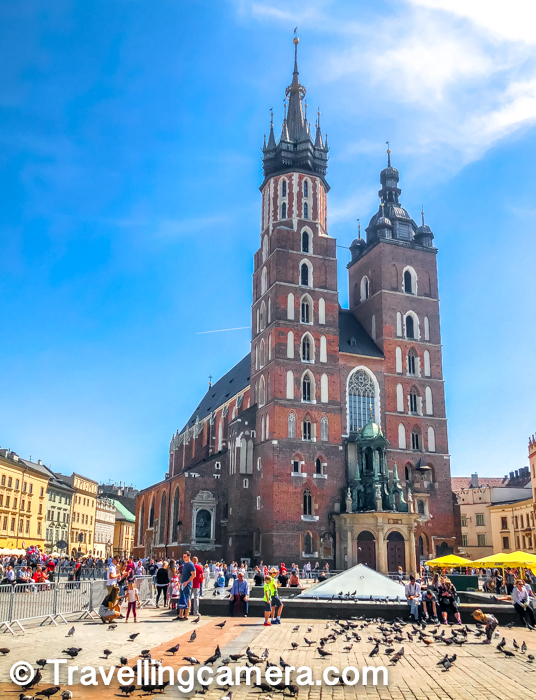
Notice the worn stone around a doorway. A bicycle leaning against a centuries-old wall. A tram disappearing around a corner. A shopkeeper arranging bread in the morning. The changing expressions of people sitting beneath umbrellas in a café. The way late-afternoon light hits the brick towers of St. Mary's Basilica.
That is when Krakow starts revealing itself.
The city's Historic Centre is a UNESCO World Heritage Site, encompassing the medieval city, Wawel Hill and historic Kazimierz. UNESCO describes the area as an unusually well-preserved urban ensemble whose architecture reflects centuries of European history.
For a photographer, that density is almost overwhelming.
For a traveler, it is liberating.
You can spend a morning walking through royal history, an afternoon exploring Jewish heritage in Kazimierz, an evening eating something warm in a small restaurant and still find yourself stopping for photographs on the way back to the hotel.
And perhaps that is the best way to experience Krakow: slowly, on foot, with enough time to get slightly lost.

Why Visit Krakow in Poland?
Krakow is one of the most rewarding destinations in Poland because it combines several experiences that are often separated in other European cities.
You get:
A remarkably preserved medieval centre
Royal Polish history at Wawel
Jewish heritage and culture in Kazimierz
World-class museums
Atmospheric streets and courtyards
Excellent cafés and traditional Polish food
Easy access to Wieliczka Salt Mine
Riverfront walks along the Vistula
Strong photography opportunities
An unusually walkable historic centre
It also makes an excellent starting point for exploring the main cities in Poland.
Warsaw tells a very different story. Gdańsk feels maritime and Hanseatic. Wrocław has its own architectural character and whimsical urban details. Poznań has a strong commercial and historical identity.
Krakow, however, feels like a city where the past is still physically present.
You don't have to search for history here.
You walk into it.

Krakow in Poland: Understanding the City's Historical Soul
Krakow's history is far deeper than its attractive Old Town suggests.
The city was chartered in 1257 under Magdeburg law, and its medieval street layout remains remarkably legible today. UNESCO's protected Historic Centre includes Krakow's medieval core, Wawel Hill and Kazimierz.
For centuries Krakow was the political and cultural centre of Poland.
Wawel Hill became the seat of royal power. Kings were crowned and buried here. The cathedral became a royal necropolis. Artists, scholars and craftsmen were drawn to the city.
The Jagiellonian University, founded in 1364, helped establish Krakow as one of Central Europe's great intellectual centres.
Then came a dramatic change.
In the early 17th century, King Sigismund III Vasa moved the royal court permanently to Warsaw. Wawel gradually lost its political importance, although its symbolic significance remained enormous. The Wawel Royal Castle today describes the hill as the most historically and culturally important site in Poland.
This is one of the fascinating things about Krakow.
Its importance isn't simply visible in grand monuments.
It survives in the city's layers.
Medieval streets sit beside Renaissance buildings. Churches stand beside cafés. Jewish neighbourhoods exist beside modern restaurants. Soviet-era architecture appears far beyond the postcard version of Krakow.
The city feels less like a museum and more like a historical document that people continue to live inside.

Wawel Castle: Where Krakow's Royal Story Begins
If Krakow had a visual anchor, it would be Wawel.
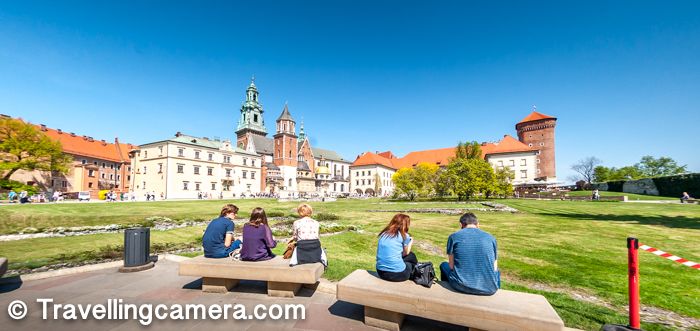
The limestone hill rises beside the Vistula River, crowned by the Royal Castle and cathedral.
For photographers, the approach matters as much as the destination.
Instead of rushing straight to the castle, walk through Kanonicza Street.
It is one of those streets where the camera almost seems to photograph itself. Narrow façades, uneven surfaces, doorways, architectural details and changing shadows create natural frames.
Then climb toward Wawel.
The castle courtyard is particularly rewarding because the Renaissance arcades create repeating patterns and layers.
Don't photograph only the building.
Photograph the people moving through it.
A solitary visitor under an arch can give scale to the enormous architecture. A family crossing the courtyard can add a sense of movement to an otherwise static historical scene.
The Wawel collection includes paintings, sculpture, textiles, furniture, armour and other objects associated with the royal residence.
A strange detail worth noticing
Look at the wall as you approach Wawel from Kanonicza Street.
You will see stones carrying donors' names.
These are part of a fascinating fundraising story from the early 20th century, when Poland was rebuilding Wawel after years of neglect and foreign occupation. Donors who contributed significant amounts were allowed to have inscriptions placed on the restoration wall.
It is a small detail.
But it tells a much bigger story about how strongly Wawel was connected to Polish national identity.
Krakow in Poland Through the Eyes of a Photographer
Krakow rewards photographers who resist the temptation to photograph everything like a postcard.
The obvious compositions are beautiful.
But the strongest images often come from the spaces between them.
Rynek Główny Early in the Morning
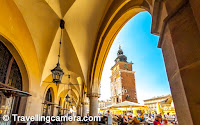
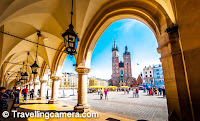
The Main Market Square is one of Europe's largest medieval market squares and one of Krakow's defining spaces. UNESCO specifically highlights its scale and historic urban character.
Come early.
Very early.
The difference between 7 a.m. and 11 a.m. can feel like the difference between two cities.
At sunrise, delivery workers, cleaners, early commuters and local residents occupy the square. Tourist groups haven't yet filled the space.
This is when you can photograph architecture without fighting for a clean frame.
Try:
Wide-angle compositions showing the scale of the square
Telephoto compression of St. Mary's towers
Reflections after rain
People crossing the square
Details of façades
Morning café scenes
If the weather is cloudy, don't immediately put the camera away.
Soft light can be excellent for architectural photography because it reduces harsh contrast.
St. Mary's Basilica and the Hejnał
Every hour, a trumpet call known as the hejnał is played from the taller tower of St. Mary's Basilica.
The melody abruptly stops.
There is a famous legend behind it.
According to the story, a medieval watchman saw approaching Tatar forces and sounded the alarm. Before he could finish, an arrow struck him. The interrupted melody supposedly commemorates his final notes.
The more interesting detail is that the legend itself is relatively recent. Krakow's tourism authority notes that the famous version appeared in a 20th-century publication, despite the much older tradition of the bugle call.
That distinction is worth remembering when traveling.
Cities don't only preserve history.
They create stories around history.

Photography tip
Don't necessarily photograph the tower while the trumpet is playing.
Instead, watch the people.
Visitors stop.
Heads turn upward.
Phones come out.
Children point.
For a documentary photographer, that moment of collective attention can be more interesting than the tower itself.

Kazimierz: The Krakow You Should Not Rush Through
If the Old Town introduces you to Krakow's medieval identity, Kazimierz introduces you to a more complicated and deeply human history.
Kazimierz was historically a separate town before becoming part of Krakow. Its identity was shaped by both Catholic and Jewish communities, a cultural coexistence that remains central to the district's heritage. UNESCO includes Kazimierz within Krakow's Historic Centre World Heritage property.
Today, Kazimierz is filled with cafés, restaurants, bars, galleries, antique shops and restored buildings.
But don't let the contemporary atmosphere obscure what came before.
Walk slowly around:
Szeroka Street
Plac Nowy
Old synagogues
Small courtyards
Jewish cemetery areas
Former industrial spaces
Side streets away from the main restaurant clusters
The strongest experience here comes from noticing the contrast.
A beautifully restored building may stand beside a weathered façade.
A fashionable café may occupy a building whose history is far older than the café itself.
Photography here should be respectful.
Kazimierz's Jewish heritage is not simply an aesthetic theme. It is connected to a community and history marked by persecution, displacement and loss.
Photograph architecture.
Photograph contemporary life.
But avoid turning memorial spaces or religious sites into props.

Podgórze and Krakow's More Difficult History
Cross the Vistula and Krakow changes character again.
Podgórze is especially important for understanding the city's 20th-century history.
Oskar Schindler's Enamel Factory is now a branch of the Museum of Krakow. Its permanent exhibition, Krakow under Nazi Occupation 1939–1945, focuses on the city's experience during the German occupation.
This is not an attraction to rush through.
Give it time.
The museum is valuable because it puts wartime history into the context of ordinary urban life: streets, homes, workplaces, families and the machinery of occupation.
For travelers interested in history, it provides a necessary counterweight to Krakow's romantic Old Town.

Hidden Krakow: Places Beyond the Classic Route
One of the biggest mistakes visitors make is assuming Krakow ends where the guidebook's Old Town map ends.
It doesn't.
Stary Kleparz
Stary Kleparz is a traditional market area where the city feels more everyday and less curated for visitors.
This is a good place to observe local food culture.
Look at what people actually buy.
Vegetables.
Bread.
Cheese.
Flowers.
Seasonal produce.
For photographers, markets provide something monuments cannot: unpredictable human interaction.
Use a small lens and observe before photographing.
Nowa Huta
For a completely different Krakow, take the tram toward Nowa Huta.
The district was planned as a socialist industrial city and has an entirely different architectural language from the medieval centre.
Wide avenues replace narrow medieval lanes.
Monumental planning replaces intimate courtyards.
Concrete and symmetry replace ornate façades.
For architectural and documentary photographers, this contrast is fascinating.
Krakow even has an active photography culture around Nowa Huta; the Nowa Huta Cultural Centre has hosted photography exhibitions including documentary, architecture and street photography.
If you have already photographed the postcard version of Krakow, Nowa Huta gives you a completely different visual vocabulary.

Best Photography Spots in Krakow
| Location | Best Time | What to Photograph |
|---|---|---|
| Rynek Główny | Early morning | Architecture, people, street scenes |
| St. Mary's Basilica | Blue hour / morning | Towers, façades, people |
| Cloth Hall | Early morning | Symmetry and details |
| Kanonicza Street | Morning / late afternoon | Architecture and shadows |
| Wawel Castle | Morning | Arcades, architecture, portraits |
| Vistula Boulevards | Golden hour | River, skyline, silhouettes |
| Kazimierz | Late afternoon | Street life and architecture |
| Plac Nowy | Evening | Food, people, atmosphere |
| Podgórze | Afternoon | Documentary photography |
| Nowa Huta | Daytime | Architecture and urban geometry |
| Wieliczka Salt Mine | During tour | Underground architecture and textures |

Photography Tips for Krakow
Krakow is unusually friendly to photographers because so many visual opportunities are within walking distance.
1. Carry a versatile lens
A 24–70mm equivalent is excellent for general travel photography.
A compact 35mm or 50mm lens is even better for street photography.
2. Look for layers
Krakow's streets often provide foreground, middle ground and background naturally.
A doorway in the foreground.
A pedestrian in the middle.
A church tower behind.
Wait for the right person to enter the frame.
3. Photograph at both ends of the day
The middle of the day is often the least interesting time for architecture.
Early morning gives you cleaner compositions.
Late afternoon gives façades warmer directional light.
Blue hour transforms Krakow into something more theatrical.
4. Use bad weather
Wet cobblestones can be spectacular.
Rain gives you reflections.
Fog softens distant architecture.
Snow simplifies the visual environment.
Clouds can create dramatic skies around Wawel.
5. Don't photograph only buildings
Krakow's people are part of the visual story.
Tram passengers.
Market sellers.
Students.
Street musicians.
Café customers.
Tour guides.
Cyclists.
The elderly couple walking slowly across a square may tell you more about Krakow than another photograph of a church façade.

What to Eat in Krakow
You don't need expensive restaurants to understand Polish food.
Start with simple things.
Pierogi
Poland's famous dumplings come with numerous fillings, from savoury cheese and potato combinations to meat, mushrooms and seasonal variations.
Try more than one style.
The difference between a handmade dumpling and a mass-produced version becomes obvious quickly.
Obwarzanek Krakowski
Don't confuse this with an ordinary pretzel.
The ring-shaped bread is a Krakow specialty and one of the city's simplest street foods.
You will see vendors selling it around the city.
Buy one.
Eat it while walking.
That is part of the experience.
Zapiekanka
Head to Kazimierz and look for zapiekanka, a long open-faced toasted bread traditionally topped with mushrooms, cheese and other ingredients.
It is inexpensive, filling and deeply associated with Krakow's street-food culture.
Żurek
This sour rye soup is particularly satisfying on a cold day.
The combination of fermented rye, sausage and egg gives it a distinctive flavour.
Local markets
For travelers who want to understand food beyond restaurants, spend some time around local markets.
Stary Kleparz is particularly useful because it gives you a glimpse into everyday food shopping rather than simply tourist dining. The city also hosts periodic food and design events there.

Human Stories: The Krakow Behind the Monuments
Travel becomes memorable when a destination stops being a collection of places.
In Krakow, this can happen surprisingly quickly.
A café owner explaining a Polish pastry.
A tram driver waiting patiently for an elderly passenger.
A market seller arranging vegetables.
A university student walking across the Old Town with books under one arm.
A musician playing in a side street.
These are small encounters.
But they give scale to history.
One of the pleasures of slow travel in Krakow is that you don't have to manufacture these moments.
You simply have to stop moving quickly enough to notice them.

Best Time to Visit Krakow
Krakow works throughout the year, but each season changes the character of the city.
Spring
Spring brings softer colours, longer daylight and increasingly comfortable walking conditions.
It is a particularly good season for photography.
Summer
Summer offers long days and lively evenings.
The downside is obvious: more visitors.
If you travel in summer, start your photography days early and explore popular places before breakfast.
Autumn
Autumn may be the most rewarding season for photographers.
The light becomes softer.
Trees change colour.
The city feels less frantic than during peak summer.
Winter
Winter can be magical when snow arrives.
But daylight hours are short and temperatures can be harsh.
The advantage is atmosphere.
A snowy Rynek at dawn can feel dramatically different from the same place in July.

My preferred strategy
Regardless of season, build your day around early mornings and late afternoons.
Use the middle of the day for museums, food and slower exploration.
That simple change can dramatically improve both your experience and your photographs.

How to Reach Krakow
Krakow is one of Poland's easiest international city breaks.
The main airport is John Paul II Kraków Airport, located west of the city.
The airport has a railway station directly adjacent to the terminal, connected by a covered footbridge. The SKA1 train links Krakow Airport with Krakow Main Station and continues toward Wieliczka. The current airport information lists the Krakow Airport–Krakow Main Station fare at PLN 20.
This is particularly convenient if you are traveling without a car.
By train
Krakow Main Station is extremely useful for travelers combining Krakow with other main cities in Poland.
You can build a multi-city itinerary around:
Krakow → Warsaw → Gdańsk
or
Krakow → Wrocław → Poznań
depending on your interests and available time.

Getting Around Krakow
The historic centre is best explored on foot.
Seriously.
You will miss some of the city's character if you spend your entire trip moving between attractions by vehicle.
For longer distances, use trams and buses.
Krakow's public transport system covers the city and surrounding zones, with tickets available through ticket machines and several mobile applications.
For visitors, apps such as Jakdojade can be particularly useful for route planning.
One important point: don't assume every ticket is interchangeable across every transport situation.
Check the applicable zones and ticket conditions before traveling, especially when heading outside the central area.

Where to Stay in Krakow
Your choice of neighbourhood can significantly change your experience.
Old Town
Best for first-time visitors who want to walk almost everywhere.
You will be close to major landmarks, restaurants and historic streets.
The disadvantage is that some areas can become busy and tourist-heavy.
Kazimierz
Better for travelers who prefer cafés, restaurants, nightlife, history and a more neighbourhood-like atmosphere.
For photographers, it is arguably more interesting than staying directly beside the Main Market Square.
Podgórze
A good choice for travelers looking for a quieter base and proximity to important historical sites.
Around the railway station
Convenient for short stays and travelers making onward train journeys.
For a photography-focused trip, however, I would favour a neighbourhood where you can step outside early in the morning and immediately start walking.

Krakow Budget Tips
Krakow can be enjoyed without an extravagant budget.
Some of the best experiences cost nothing:
Walking through the Old Town
Exploring historic streets
Photographing public spaces
Walking beside the Vistula
Exploring Kazimierz
Visiting markets
Watching the city's street life
Exploring neighbourhood architecture
Spend selectively on the experiences that add depth.
For example:
Wawel exhibitions
Museums
Wieliczka Salt Mine
Guided historical walks
Selected cultural performances
Avoid spending your entire budget on accommodation in the most tourist-heavy part of the Old Town simply for convenience.
Krakow is compact enough that staying slightly farther away can still work very well.

A Practical 3-Day Krakow Itinerary
Day 1: Medieval Krakow
Morning
Start at Rynek Główny before the crowds.
Photograph St. Mary's Basilica and the surrounding architecture.
Walk through the Cloth Hall and continue toward Florian Gate.
Afternoon
Explore the Old Town's side streets.
Have lunch somewhere away from the busiest square.
Then walk toward Wawel through Kanonicza Street.
Evening
Walk along the Vistula.
Return toward the Old Town around blue hour.
This is the day for classic Krakow photographs.
Day 2: Kazimierz and Podgórze
Morning
Begin in Kazimierz.
Explore the synagogues, streets and courtyards.
Visit local cafés rather than trying to cover the neighbourhood at speed.
Afternoon
Walk toward Podgórze.
Visit Oskar Schindler's Enamel Factory if its history interests you. Tickets are limited, and the museum recommends checking availability and booking arrangements in advance.
Evening
Return to Kazimierz.
Explore Plac Nowy.
Try zapiekanka.
Then simply wander.
This is your street-photography day.
Day 3: Wieliczka or Krakow Beyond the Old Town
You have two choices.
Option A: Wieliczka Salt Mine
The Wieliczka Salt Mine is one of the world's more unusual heritage experiences.
Salt has been mined here since the 13th century, and the UNESCO-listed complex contains underground galleries, chapels, sculptures and historic mining infrastructure.
It is more than a tourist attraction.
It is a glimpse into an industrial world built underground.
Option B: Nowa Huta
If you have already seen enough medieval architecture, go to Nowa Huta.
Photograph the geometry.
Wide avenues.
Large civic spaces.
Concrete.
Symmetry.
Everyday life.
It is a fascinating reminder that Krakow is not frozen in the Middle Ages.
Responsible Travel in Krakow
Krakow's popularity brings pressure.
Travel thoughtfully.
Respect religious spaces
Churches are active places of worship.
Dress appropriately and avoid photographing people during prayer without permission.
Be especially sensitive in Jewish heritage areas
Understand the history before photographing memorials and cemeteries.
Don't turn difficult history into entertainment
Places associated with Nazi occupation, persecution and wartime suffering deserve a different photographic approach from a picturesque street.
Support local businesses
Eat at independent restaurants.
Buy from local producers.
Visit neighbourhood cafés.
Use local guides where appropriate.
The money you spend can help preserve the living city rather than simply feeding its tourism economy.

Common Mistakes to Avoid in Krakow
Spending the entire trip around Rynek
The Main Market Square is spectacular.
But Krakow is much larger than its postcard centre.
Visiting Wawel at the busiest time
Go early when possible.
The experience is calmer and the light is often better.
Treating Kazimierz as only a nightlife district
Its historical significance is much deeper.
Walk slowly.
Read.
Observe.
Ignoring Nowa Huta
If you are interested in photography and architecture, this can be one of the most visually rewarding detours.
Taking only daytime photographs
Krakow changes dramatically after sunset.
Trying to see everything
This is perhaps the biggest mistake.
Krakow rewards depth more than speed.

Frequently Asked Questions About Krakow in Poland
Is Krakow worth visiting?
Yes. Krakow combines medieval architecture, royal history, Jewish heritage, museums, Polish food, neighbourhood culture and excellent photography opportunities in a relatively compact city.
How many days do you need in Krakow?
Three days is a good starting point. A longer stay of four or five days allows time for Wieliczka, Nowa Huta, museums and slower exploration.
Is Krakow expensive?
Compared with many major Western European destinations, Krakow can be relatively affordable, particularly for food, public transport and independent accommodation. Costs vary considerably depending on season and accommodation level.
What are the best places to photograph in Krakow?
Start with Rynek Główny, St. Mary's Basilica, Kanonicza Street, Wawel, the Vistula Boulevards and Kazimierz. For something different, explore Podgórze and Nowa Huta.
Is Krakow good for solo travelers?
Very much so. The central areas are walkable, public transport is useful and there are many cafés, museums and neighbourhoods that can be explored independently.
What food should I try in Krakow?
Try pierogi, obwarzanek krakowski, zapiekanka and żurek. Local markets are also worthwhile for understanding everyday Polish food culture.
Is Wieliczka Salt Mine worth visiting from Krakow?
Yes, particularly for travelers interested in history, architecture, engineering or unusual heritage sites. The mine forms part of the UNESCO-listed Wieliczka and Bochnia Royal Salt Mines.
What is the best time to photograph Krakow?
Early morning and late afternoon are generally the most rewarding. Morning gives cleaner streets and softer light, while late afternoon and blue hour create stronger atmosphere.
How do you get from Krakow Airport to the city centre?
The airport railway station is directly connected to the terminal by a covered footbridge. The SKA1 service connects the airport with Krakow Main Station.
Can Krakow be combined with other Polish cities?
Absolutely. Krakow works particularly well as part of a larger Poland itinerary involving Warsaw, Wrocław, Poznań or Gdańsk. Each city offers a distinctly different interpretation of Polish history and urban culture.

Final Thoughts: Don't Just Visit Krakow. Walk Into It.
There is a version of Krakow that can be completed in a day.
You see the Main Market Square.
Photograph St. Mary's.
Walk around Wawel.
Eat pierogi.
Take a few photographs.
Tick the boxes.
Then leave.
But that isn't the Krakow I would recommend.
The more interesting Krakow appears when you slow down.
Walk away from the square.
Sit in a café without checking the time.
Take the tram somewhere simply because you have never been there.
Stand beside the Vistula at sunset.
Watch the hejnał crowd gather around St. Mary's.
Walk through Kazimierz after the afternoon tourists have disappeared.
Look closely at the restoration stones around Wawel.
Photograph the ordinary.
Listen to conversations you don't fully understand.
Eat something you cannot pronounce.
And leave some photographs unplanned.
That is where travel photography becomes more than collecting beautiful pictures.
Krakow has plenty of beautiful pictures.
What makes the city memorable is everything underneath them.
Its royal ambitions.
Its religious traditions.
Its Jewish heritage.
Its wartime scars.
Its socialist-era neighbourhoods.
Its markets.
Its students.
Its cafés.
Its trams.
Its legends.
Its people.
The Historic Centre has survived remarkably well, but Krakow itself is not a preserved object. It is still changing. UNESCO's recognition is partly about the continuity of its urban fabric and the way different historical periods remain visible together.
And perhaps that is the most rewarding thing about photographing Krakow in Poland.
You are not simply photographing the past.
You are photographing a city where the past and present keep crossing paths.
Sometimes in a medieval square.
Sometimes in a tram.
Sometimes in the face of a stranger.
And sometimes, quite unexpectedly, in the frame you almost decided not to take.
Related Blogposts -







.jpg)
Comments