

Few birds capture the imagination quite like the kingfisher. With its jewel-like plumage, lightning-fast dives, and remarkable hunting skills, the kingfisher is one of the most fascinating birds found across Asia, Europe, Africa, and the Americas. Whether you are a birdwatcher, wildlife photographer, or simply someone who enjoys spending time in nature, spotting a kingfisher is always a memorable experience.

For photographers, the kingfisher is both a dream and a challenge. Its brilliant colors stand out beautifully against rivers, lakes, and forests, but its incredible speed means that capturing the perfect moment requires patience, observation, and a little luck.

In this article, we explore the world of kingfishers—from their behavior and habitat to photography tips and conservation—while understanding why these colorful birds continue to inspire nature lovers around the globe.

Meet the Kingfisher
Kingfishers belong to the family Alcedinidae, although the broader kingfisher group includes nearly 90 different species distributed across several families. Despite their common name, not every kingfisher feeds primarily on fish.
These birds vary greatly in size. The smallest species measure only about 10 centimeters, while the largest can exceed 40 centimeters. Their colors range from brilliant blue and turquoise to emerald green, chestnut, orange, black, and white.
One characteristic remains common across nearly all species:
- Large head
- Long, pointed bill
- Compact body
- Short tail
- Strong eyesight
- Extremely fast flight
Their aerodynamic design makes them exceptionally efficient hunters.

Why Are They Called Kingfishers?
The name "kingfisher" comes from their extraordinary ability to catch fish. Many species perch silently above water before diving headfirst to capture fish with incredible precision.
However, this name can be misleading because several kingfisher species rarely eat fish. Instead, they hunt:
- Lizards
- Frogs
- Crabs
- Snakes
- Insects
- Worms
- Small birds
- Rodents
Their diet depends entirely on their habitat.

Where Can You Find Kingfishers?
Kingfishers inhabit an astonishing variety of environments.
These include:
- Rivers
- Streams
- Lakes
- Wetlands
- Mangrove forests
- Coastal regions
- Tropical rainforests
- Agricultural fields
- Village ponds
- Urban parks with water bodies
India is home to several beautiful kingfisher species, making it one of the best countries for observing these birds.

Kingfisher Species Found in India
India hosts around 12 species of kingfishers, each with unique characteristics.
Common Kingfisher
The Common Kingfisher is perhaps the most iconic species.
It is tiny but incredibly colorful, displaying electric blue upperparts and rich orange underparts. Watching it dive into still water feels almost magical.
White-throated Kingfisher
Perhaps the easiest kingfisher to spot in India, this species is equally comfortable far away from water.
Its striking combination of:
- Chocolate-brown head
- Bright turquoise wings
- White throat
- Large red bill
makes it unmistakable.
Interestingly, it feeds on insects, frogs, reptiles, and small mammals much more often than fish.
Pied Kingfisher
Unlike many colorful kingfishers, the Pied Kingfisher wears elegant black-and-white plumage.
Its most impressive behavior is hovering in mid-air before plunging vertically into water.
Watching this aerial hunting display is unforgettable.
Stork-billed Kingfisher
One of India's largest kingfishers, the Stork-billed Kingfisher features:
- Green wings
- Blue back
- Buff underparts
- Massive red bill
It inhabits mangroves, rivers, and forest streams.
Crested Kingfisher
Found mainly in the Himalayan region, this magnificent bird sports a distinctive crest and dramatic black-and-white plumage.
It prefers fast-flowing mountain rivers.

A Master Hunter
The kingfisher's hunting technique demonstrates extraordinary precision.
The bird first chooses a suitable perch overlooking the water.
From this position, it remains perfectly still, sometimes for several minutes.
Its exceptional eyesight allows it to detect even tiny fish swimming below the surface.
Once prey is spotted:
- The bird locks onto the target.
- It launches into a rapid dive.
- Its eyes adjust for the refraction caused by water.
- It catches the fish with its sharp bill.
- It returns to the perch.
Before swallowing larger prey, the kingfisher repeatedly strikes it against a branch to stun or kill it.

Incredible Eyesight
Kingfishers possess some of the best vision among birds.
Their eyes can:
- Judge depth accurately
- Compensate for water distortion
- Focus both in air and underwater
- Detect rapid movement
A transparent membrane protects their eyes during dives without significantly affecting visibility.

Built for Speed
Although kingfishers appear small and delicate, they are remarkably powerful flyers.
Their wings beat rapidly, enabling:
- Sudden acceleration
- Sharp turns
- High-speed dives
- Quick escapes from predators
Most flights are short, direct, and incredibly fast.

Nesting Habits
Unlike many birds that build nests in trees, kingfishers excavate tunnels.
Both parents dig tunnels into:
- Riverbanks
- Sandy cliffs
- Mud embankments
- Earthen walls
These tunnels may extend over one meter before ending in a nesting chamber.
The female lays several glossy white eggs, and both parents share incubation and feeding responsibilities.

Family Life
Kingfisher parents work tirelessly to raise their chicks.
Thousands of hunting trips may be required before the young birds become independent.
Young kingfishers initially lack the brilliant coloration of adults, gradually developing vibrant plumage over time.

Why Are Kingfishers So Colorful?
The dazzling blue feathers are not produced by blue pigments.
Instead, they result from structural coloration.
Tiny microscopic structures within the feathers scatter light, reflecting blue wavelengths while absorbing others.
This phenomenon is similar to:
- Peacock feathers
- Butterfly wings
- Some beetles
This explains why the color seems to change depending on lighting conditions.
 |
| White-throated Kingfisher |
The Role of Kingfishers in Nature
Kingfishers play an important ecological role.
They help maintain healthy populations of:
- Fish
- Insects
- Frogs
- Aquatic organisms
Because many species depend on clean water, their presence often indicates a healthy ecosystem.
A river rich in kingfishers is usually a good sign for biodiversity.

Threats Facing Kingfishers
Despite their adaptability, kingfishers face numerous challenges.
Habitat Loss
Wetlands are disappearing due to urban expansion and agriculture.
Natural nesting banks are often destroyed.
Water Pollution
Industrial waste, sewage, and pesticides reduce fish populations while contaminating the birds' food sources.
Plastic Waste
Plastic pollution affects aquatic ecosystems and indirectly threatens kingfishers.
Climate Change
Changing rainfall patterns alter river systems and fish availability.
Floods can destroy nesting tunnels.
Human Disturbance
Boating, tourism, and construction activities near nesting sites may reduce breeding success.
Kingfishers and Wildlife Photography
For wildlife photographers, kingfishers are among the most rewarding birds to photograph.
However, they require patience and careful observation.
Learn Their Favorite Perches
Kingfishers often return to the same branch repeatedly.
Finding these perches greatly increases photographic opportunities.
Stay Still
Movement is your biggest enemy.
A patient photographer often enjoys far more success than one constantly changing locations.
Use Fast Shutter Speeds
To freeze diving action:
- 1/2000 second or faster
- Continuous autofocus
- Burst shooting mode
These settings improve your chances of capturing dramatic hunting sequences.
Early Morning Advantage
Soft morning light enhances feather colors while increasing bird activity.
Golden-hour photography produces particularly striking images.
Respect Wildlife
Avoid disturbing nesting birds.
Never trim branches or manipulate habitats simply for a better photograph.
Ethical photography always comes before the perfect shot.
Interesting Facts About Kingfishers
- There are nearly 90 kingfisher species worldwide.
- Not all kingfishers eat fish.
- Some species live far from water.
- Their blue feathers contain no blue pigment.
- Kingfishers can dive at astonishing speeds.
- Many species nest in underground tunnels.
- They have excellent binocular vision.
- Some kingfishers can hover before diving.
- They often swallow fish head-first.
- Both parents usually care for their chicks.
Best Places to Spot Kingfishers in India
If you enjoy birdwatching, several destinations offer excellent opportunities to observe kingfishers in their natural habitat:
- Bharatpur Bird Sanctuary (Rajasthan)
- Keoladeo National Park
- Chambal River
- Corbett National Park
- Kaziranga National Park
- Sundarbans
- Western Ghats
- Kerala backwaters
- Chilika Lake
- Ranganathittu Bird Sanctuary
- Village ponds and irrigation canals across northern India
Even city parks with lakes can occasionally surprise you with sightings of White-throated or Common Kingfishers.
Why Every Nature Lover Should Appreciate Kingfishers
Watching a kingfisher in the wild is a lesson in patience, precision, and adaptation. One moment it sits almost motionless on a branch, blending into its surroundings despite its vivid colors. The next, it transforms into a blur of motion, slicing through the air and water with remarkable accuracy before returning to its perch with a successful catch. These fleeting moments remind us how perfectly evolution has shaped each species for its way of life.
For travelers exploring rivers, wetlands, forests, or village ponds, spotting a kingfisher often becomes one of the highlights of the journey. Their presence encourages us to slow down, observe quietly, and appreciate the intricate relationships that sustain healthy ecosystems. For photographers, every encounter presents a new challenge and an opportunity to capture one of nature's most vibrant subjects.
Protecting wetlands, maintaining clean waterways, and preserving natural habitats are essential not only for kingfishers but for countless other species that depend on these environments. By valuing and safeguarding these ecosystems, we ensure that future generations can continue to experience the thrill of seeing a flash of blue dart across the water—a sight that never loses its magic.
 One day Road-Trip to Bharatpur Birds Sanctuary from Delhi : Winters Special


 Travel Guide for weekend trip from Delhi to Taj Mahal, Fatehpur Sikri and Bharatpur Bird Sanctuary
 |
| Adult Egyptian Vulture - the Indian subspecies |
Birds of Prey at Keoladeo National Park || Watchful Eyes that Track your Every Movement

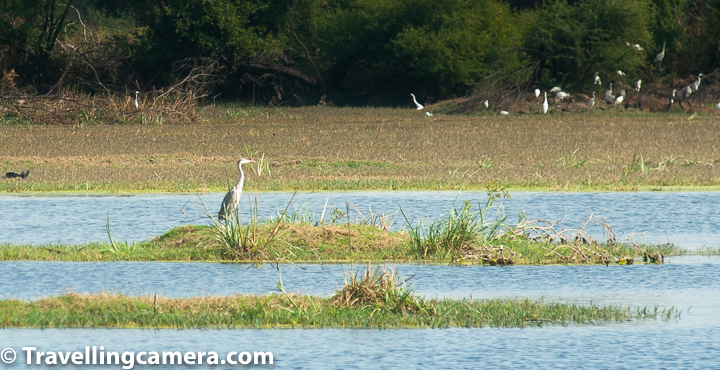 |
| Juvenile Purple Heron(?) in the foreground with Great Egrets in the Distance |
Herons and Egrets at Keoladeo National Park || Waterbirds and Waders at Bharatpur
 |
Lesser Whistling Duck |
Smaller Waterbirds at Bharatpur || Birds of Keoladeo National Park


 |
| Blue-throated Barbet |


.jpg)
Comments