
An Important Distinction: Ahilyabai Holkar's Samadhi and Ahilyeshwar Temple, Maheshwar, Madhya Pradesh

Before visiting, it is worth understanding a small but important detail about Maheshwar's heritage.
The names associated with Ahilyabai Holkar can sometimes cause confusion. Ahilyeshwar Temple, also known as Ahilyabai's Chhatri, is a distinct historic structure associated with her memory. Madhya Pradesh Tourism describes it as a temple dedicated to Lord Rama, built in her honour by her daughter, Krishnabai. It stands near the Narmada River and forms part of Maheshwar's historic architectural landscape.
The word samadhi is also used when discussing memorial sites associated with the queen. Because names and local descriptions can overlap, visitors should confirm the precise structure they intend to see rather than assuming that every reference to Ahilyabai's memorial means the same monument.
This distinction matters to anyone documenting Maheshwar's heritage. A photograph of a memorial, a temple and a royal residence may all tell different parts of the same historical story.
For a more meaningful visit, ask a local guide to explain the relationship between Ahilyabai's memorial, Ahilyeshwar Temple and the fort complex. The answer can add useful context to what might otherwise appear to be a simple architectural stop.

Exploring the Architecture and Atmosphere
Look beyond the main structure
The most rewarding way to explore a historic memorial is to slow down.
Instead of photographing only the main building, look for the smaller details that reveal how the structure has aged and how people interact with it.
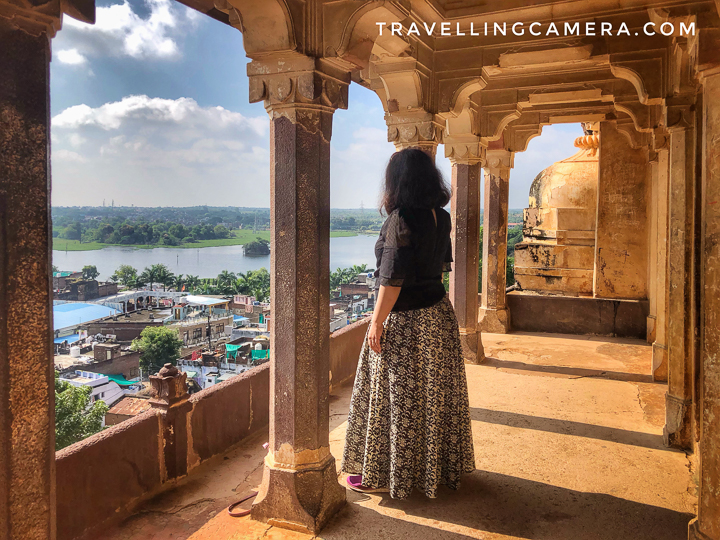
Notice the texture of the stone. Look at the junctions between walls, the proportions of openings, the shape of architectural mouldings and the way sunlight falls across different surfaces.
These observations can be especially valuable in Maheshwar, where the visual character of the town comes from the combination of historic buildings, riverfront architecture and everyday activity.
If the site is quiet, take a few minutes to observe before lifting your camera. You may notice details that are easy to miss when moving quickly between attractions.
The relationship between temples and memorial architecture
Historic religious buildings in Maheshwar are not always easy to categorise by appearance alone.
Some combine elements of temple architecture with commemorative features. Others are connected with royal patronage or memorial traditions. Their appearance reflects the religious, political and cultural practices of the period in which they were built.
This is one reason the town rewards curious travellers. A little historical context makes the architectural landscape considerably more interesting.
A place to pause rather than rush
Maheshwar's riverfront naturally attracts visitors who want to photograph the Narmada, explore the fort or watch the evening rituals.
A memorial visit can offer a different rhythm.
Spend time considering the historical figure being remembered and the relationship between her legacy and the town's present identity. There is no need to turn every moment into a photograph.
Sometimes, the best way to understand a heritage site is simply to be present.

Hidden Gems and Lesser-Known Insights Around Ahilyadevi Holkar Samadhi
The most interesting discoveries around Maheshwar often happen between the better-known attractions.
Here are a few ways to explore the area more thoughtfully.
1. Discover the smaller shrines around the riverfront
Maheshwar's ghats contain a collection of temples, shrines and architectural features that can easily be overlooked when following a conventional sightseeing itinerary.
Walk along the riverfront and look for smaller structures set between the larger monuments. Their scale and position often make them interesting subjects for architectural photography.
Some shrines are actively used for worship, while others are better understood as part of the historic built environment.
Respect the distinction between a public viewpoint and an active religious space.
2. Observe the changing life of the ghats
The ghats are not merely a scenic backdrop. They are part of the daily life of Maheshwar.
Depending on the time of day, you may see people arriving for prayer, residents carrying out everyday tasks, pilgrims visiting shrines or visitors sitting quietly beside the river.
The atmosphere changes considerably between early morning, midday and evening.
Rather than visiting only at sunset, consider returning at different times. You will see different light, different activities and different relationships between the buildings and the river.
3. Look for the connection between royal history and local weaving
Maheshwar's association with Maheshwari textiles is one of the most tangible links between Ahilyabai's legacy and contemporary life.
The weaving tradition is closely associated with her patronage, and the craft continues through local artisans and weaving organisations. The Rehwa Society, established by the Holkar family in the late 1970s, has played an important role in supporting the town's handloom tradition and providing livelihoods for women weavers.
A visit to a working handloom centre adds a useful dimension to a heritage trip. It shows how cultural preservation can involve skills, employment and living communities rather than architecture alone.
4. Visit the riverfront after the main sightseeing rush
If you have time, return to the ghats after completing your main sightseeing.
As the light softens, the stone architecture becomes more visually layered. The river reflects changing colours, and the fort and temples acquire a different character from the one they have under harsh midday sunlight.
Choose a place where you can sit without obstructing worshippers or people using the steps.
The quieter moments often become the most memorable part of a visit to Maheshwar.
5. Explore beyond the main riverfront
If you are spending more than a day in Maheshwar, consider exploring nearby heritage and religious destinations.
Options include:
Sahastradhara: A river landscape near Maheshwar known for its rocky formations and seasonal changes in the flow of the Narmada.
Mandleshwar: A historic riverside town with religious significance.
Mandu: A remarkable heritage destination known for its palaces, gateways, mosques and historic water structures.
Omkareshwar: An important pilgrimage destination associated with Lord Shiva.
These places have different travel requirements, so check road conditions and travel times before combining them into a single itinerary.

Best Photography Spots Around Ahilyadevi Holkar Samadhi Temple
For photographers, Maheshwar is a place where architecture, water, history and everyday life come together.
The challenge is not finding something to photograph. It is deciding what story each frame should tell.
1. Architectural details at the memorial
Start with the structure itself.
Look for repeating patterns, stone textures, doorways and the interplay between light and shadow. Architectural details often communicate the age and character of a building more effectively than a wide photograph.
A standard or short telephoto lens is useful for isolating details without including too much visual clutter.
If the site is busy, focus on architectural elements that can be photographed without including visitors.
2. The historic riverfront
The Narmada ghats are among the most recognisable photographic landscapes in Maheshwar.
From suitable public viewpoints, frame the stone steps, temples, pavilions and fort walls as parts of one composition.
A wide-angle lens can capture the scale of the riverfront, but avoid using an excessively wide focal length if it distorts the architecture.
Try a second composition with a longer focal length to isolate a temple spire, a pavilion or a repeating sequence of stone steps.
3. Reflections on the Narmada
On relatively calm mornings, reflections can add symmetry and visual depth to photographs of Maheshwar's historic buildings.
Look for moments when the water is sufficiently still to reflect the structures above it. Even when the surface is moving, broken reflections can create attractive patterns.
The results depend on the weather, wind and water conditions. Do not expect mirror-like reflections every day.
4. Temples and the ghats in late-afternoon light
Late afternoon is particularly useful for photographing the historic riverfront.
As the sun lowers, architectural details may become more pronounced, while the overall scene takes on warmer tones.
Look for opportunities to photograph the relationship between the temples and the river rather than treating each structure as an isolated subject.
A vertical frame can emphasise the height of the architecture. A horizontal frame is better suited to showing the long sweep of the ghats.
5. Everyday life around the temples
If you enjoy documentary photography, the surroundings offer opportunities to record the human dimension of Maheshwar.
You might photograph a row of footwear outside a shrine, the texture of a well-used stone staircase, a temple bell or the movement of boats along the river.
When photographing people, particularly worshippers, ask for permission when appropriate. Avoid photographing private moments of prayer or bathing without consent.
The aim should be to document the place respectfully, not to turn people into props.

Photography Tips for Maheshwar
| Photography subject | Recommended time | Useful approach |
|---|---|---|
| Memorial architecture | Early morning or late afternoon | Look for soft light and architectural details |
| Narmada ghats | Sunrise and late afternoon | Use wide compositions to show the riverfront |
| Stone textures | When sunlight falls at an angle | Use directional light to emphasise surface detail |
| River reflections | Early morning, when the water is calm | Include both the architecture and its reflection |
| Evening rituals | Around dusk, subject to local activity | Balance available light with respect for worshippers |
| Maheshwari textiles | During suitable visiting hours at a weaving centre | Photograph patterns, tools and the weaving process with permission |
Recommended camera settings
For architectural photography, start with an aperture around f/8 if you want good depth of field across the structure. Adjust your shutter speed and ISO according to the available light.
A tripod can help in low-light conditions, but use one only where permitted and where it will not obstruct visitors.
For handheld photography near dusk, a faster shutter speed may be necessary if people are moving through the frame. Raising the ISO is often preferable to losing important moments to motion blur.
If you are using a smartphone, avoid relying entirely on digital zoom. Move to a suitable public viewpoint when possible, and tap to focus on the important part of the scene.
A useful composition exercise
Try photographing the same architectural feature three ways:
A wide frame that shows the structure in its surroundings.
A medium frame that emphasises its proportions and design.
A close frame that highlights a distinctive detail.
This simple exercise produces a more complete visual record of the place and is particularly useful when creating a photo essay for a travel blog.
Photography etiquette
Before taking photographs, check whether photography is permitted at the specific site.
Avoid photographing restricted areas, entering sanctums with a camera when prohibited or interrupting ceremonies for a better angle. Drone photography should not be attempted without checking applicable restrictions and obtaining any required permissions.
Remember that a heritage site may be an active place of worship rather than a public photographic set.

Local Food Experiences: What to Eat in Maheshwar
A visit to Maheshwar is not complete without exploring its food.
The town's everyday eating culture is shaped by the broader culinary traditions of Madhya Pradesh and the Malwa region. Meals tend to be practical and comforting, with vegetarian options widely available around the religious and tourist areas.
Try a traditional vegetarian thali
A thali is a convenient way to sample several dishes in one meal.
Depending on the restaurant, you may find roti, seasonal vegetables, dal, rice, chutneys and other regional preparations.
Ask what is freshly prepared that day rather than assuming every restaurant serves the same menu.
Smaller eateries can offer a more straightforward experience than restaurants designed primarily for tourists.
Look for poha and other local breakfast favourites
Poha is a familiar breakfast across much of Madhya Pradesh. It is often served with sev, coriander, lemon and other accompaniments.
It is a useful option before a morning of sightseeing because it is generally quick, filling and affordable.
Availability and preparation vary from one establishment to another, so follow local recommendations when choosing where to eat.
Explore the food traditions of Malwa
If your journey through Madhya Pradesh includes other destinations, look out for regional dishes such as dal bafla, a traditional preparation often served with ghee and accompaniments.
The precise menu in Maheshwar will depend on the restaurant, and not every regional speciality is available everywhere.
Ask residents which dishes they associate with home cooking. Their recommendations may lead you to more interesting meals than a search for the most popular restaurant.
Food photography tips
Natural light near a window is usually better than harsh overhead lighting.
For a thali, photograph the full arrangement first, then capture close-ups of individual dishes. A slightly elevated angle helps show the variety of food, while a lower angle can work well for a bowl or glass.
Always ask before photographing staff or other diners.
Local Conversations and Human Stories
One of the most rewarding ways to experience Maheshwar is to talk to people who live and work here.
The town's history is often introduced through the story of Ahilyabai Holkar. However, residents encounter that history in different ways: through religious traditions, the architecture around them, local stories, family memories and the continued importance of weaving.
Ask about the queen's legacy
If you speak with a guide or resident, ask what Ahilyabai Holkar means to Maheshwar today.
The answer may focus on her administration, religious patronage, the town's historic buildings or the way her name remains part of local identity.
Not every person will tell the same story, and that is part of the interest. Historical memory is shaped by education, family traditions and personal experience.
Listen without expecting every local account to be a verified historical fact.
Talk to the weavers
Maheshwar's handloom tradition offers another way to understand the relationship between history and contemporary life.
If you visit a weaving centre, ask about the time required to make a textile, the differences between cotton and silk blends, and the patterns associated with Maheshwari fabrics.
You may learn that what appears to be a simple border or geometric pattern involves careful planning and considerable skill.
Buy directly from an artisan or a reputable weaving organisation when possible. Ask about the materials and production process if you want to understand the value of the textile you are purchasing.

Listen to stories, but distinguish legend from history
Maheshwar is associated with traditions about the ancient city of Mahishmati and stories involving religious scholars and historical figures.
One well-known local tradition connects the area with the philosophical debate between Adi Shankaracharya and Mandana Mishra. The story is part of the region's cultural memory, although the historical details and exact location should not be treated as conclusively established merely because a local tradition identifies them.
Such stories can enrich a journey when approached with curiosity.
They are part of how communities understand their past, even when they differ from what historians can establish through documentary evidence.

Best Time to Visit Ahilyadevi Holkar Samadhi Temple
The best time to explore Maheshwar is generally between October and March, when conditions are more comfortable for walking and outdoor sightseeing. Madhya Pradesh Tourism also recommends this period for visiting the town.
However, each season offers a different experience.
| Season | What to expect | Travel and photography advice |
|---|---|---|
| October to November | The monsoon begins to recede, and the landscape may remain relatively green | Check river conditions and local access before planning riverside activities |
| December to February | Generally comfortable weather for walking and heritage exploration | Carry a light layer for early mornings and evenings |
| March | Temperatures begin rising | Start sightseeing early and take breaks during the afternoon |
| April to June | Hot conditions are common in the region | Limit long walks during the hottest hours and carry drinking water |
| July to September | Monsoon conditions can bring changing river levels and wet surfaces | Check local advice before approaching the water or planning boat trips |
Best time of day to visit
Early morning is an excellent choice for travellers who prefer cooler weather and softer light.
The historic riverfront can be particularly rewarding at this time, before the strongest sunlight reaches the stone structures.
Late afternoon is another good option, especially if you want to photograph the architecture in warmer light.
If the memorial has restricted or changing opening hours, confirm access before planning your visit around sunrise or sunset. Do not assume that every heritage structure is open at the same time as the public ghats.
When should you avoid visiting?
There is no single season that makes Maheshwar unsuitable for everyone. However, extreme summer heat can make extended outdoor exploration uncomfortable.
During the monsoon, wet steps and changing water levels require extra care. Religious festivals and public holidays may bring larger crowds, which can affect photography and travel times.
If your main interest is architectural photography, a weekday outside major festival periods may offer more flexibility.
How to Reach Ahilyadevi Holkar Samadhi Temple in Maheshwar
Maheshwar is located in the Khargone district of Madhya Pradesh, on the northern bank of the Narmada River.
Indore is the main gateway for many travellers visiting the town.
By air
The nearest major airport is Devi Ahilyabai Holkar Airport in Indore.
From the airport, continue to Maheshwar by road. You can arrange a private taxi or travel into Indore and organise onward transport.
Allow additional time for traffic, meal stops and the final approach into town.
By train
Indore is a useful railway gateway for Maheshwar, although it is not located in the town itself.
Depending on your train and route, you may also investigate rail connections serving other nearby towns. Check the current railway timetable before choosing an alternative station, as the most convenient option depends on your origin and onward transport arrangements.
From your arrival station, you will need road transport to reach Maheshwar.
By road
Maheshwar is approximately 90–100 km from Indore by road, depending on the route and starting point.
The drive generally takes around two to three hours, although traffic and road conditions can change the journey time.
Madhya Pradesh Tourism also identifies Indore as a principal access point for Maheshwar.
You can travel by private car, taxi or bus, depending on availability.
If you are travelling by bus, confirm the current departure point, frequency and arrival arrangements in Maheshwar rather than relying on an old timetable.
Getting around Maheshwar
The historic riverfront is best explored on foot where access allows.
However, the area includes stone steps, uneven surfaces and narrow passages. Comfortable footwear with a good grip is useful.
If you have limited mobility, ask locally about the most accessible approach to the particular memorial or temple you want to visit.
For nearby attractions outside the main town, arrange local transport in advance.
Where to Stay in Maheshwar
The best accommodation depends on whether you want a heritage experience, a convenient base for sightseeing or a simple place to sleep.
Heritage accommodation
Maheshwar offers accommodation within or associated with its historic fort area.
One well-known option is Ahilya Fort, a heritage property located in the former Holkar residence. The property is operated as a guest accommodation and offers a distinctive way to experience the historic setting.
This type of stay may appeal to travellers who value architecture, atmosphere and a closer connection with the town's history.
Rates can be considerably higher than those of ordinary hotels, so check the current tariff and availability before booking.
Mid-range hotels
Several hotels serve visitors looking for private rooms and convenient access to the town's main attractions.
When comparing properties, consider:
Walking distance to the historic riverfront.
Availability of air conditioning during warmer months.
Parking if you are travelling by car.
Restaurant facilities and breakfast arrangements.
Recent guest reviews.
Whether the property is located on a quiet street or a busy road.
Do not rely solely on a hotel's description of itself as being near the ghats. Check the actual walking route, particularly if you are travelling with older family members.

Budget accommodation and guesthouses
Budget hotels and simpler guesthouses can be practical for travellers who intend to spend most of their time exploring.
Compare room conditions, cleanliness, bathroom facilities and transport access before making a decision.
If you are visiting during a festival or holiday period, booking ahead is advisable.
Where should photographers stay?
If sunrise and sunset photography are priorities, staying close to the historic riverfront can make your day easier.
You will spend less time arranging transport and can return to the same location under different lighting conditions.
However, proximity to the ghats does not guarantee an unobstructed view or permission to photograph from private property. Check the actual location and facilities before booking.
Budget Tips for Visiting Ahilyadevi Holkar Samadhi Temple
Maheshwar can be explored on a modest budget if you plan transport and accommodation carefully.
The following figures are illustrative planning estimates, not verified current tariffs. Actual costs vary by season, hotel category and travel arrangements.
| Expense | Indicative budget |
|---|---|
| Simple vegetarian meal | ₹100–₹250 per person |
| Mid-range meal | ₹250–₹500 per person |
| Budget accommodation | ₹800–₹1,800 per room per night |
| Mid-range accommodation | ₹1,800–₹4,000 per room per night |
| Local transport | Depends on distance and arrangement |
| Private taxi from Indore | Depends on vehicle, route and waiting time |
1. Explore the historic centre on foot
Where practical, walking between nearby heritage sites reduces transport costs and gives you more opportunities to notice smaller details.
Allow extra time for the steps and uneven surfaces around the riverfront.
2. Visit several nearby attractions together
Group sites that are within walking distance instead of arranging separate journeys for each one.
A morning spent exploring the historic centre can include temples, the fort area and the ghats, depending on access and opening hours.
3. Choose local eateries
Simple local restaurants can provide satisfying meals without the higher prices sometimes associated with heritage accommodation.
Ask for the day's freshly prepared vegetarian options.
4. Check photography and entry rules in advance
Do not assume that all sites have free entry or that commercial photography is permitted.
Confirm any applicable charges, permissions and restrictions before visiting.
5. Avoid unnecessary transport costs
If you arrive by private taxi, agree on the return journey and waiting arrangements in advance.
If you use local transport, clarify the fare and destination before starting the trip.

Suggested Itinerary: Exploring the Temples in Maheshwar
The following itinerary combines the Ahilyadevi Holkar memorial area with the historic riverfront and other important sights.
It can be adjusted according to the location of the specific samadhi you intend to visit and the opening hours of individual sites.
One-day Maheshwar itinerary
| Time | Activity |
|---|---|
| 6:30–7:30 AM | Begin with a walk along the Narmada ghats |
| 7:30–8:30 AM | Have breakfast at a local eatery |
| 8:30–10:30 AM | Explore the historic temples and Ahilyabai-associated memorial sites |
| 10:30 AM–12:00 PM | Visit the fort and palace area, subject to access arrangements |
| 12:00–1:00 PM | Enjoy a local vegetarian lunch |
| 1:00–3:00 PM | Rest during the warmer part of the day |
| 3:00–4:30 PM | Explore a handloom centre or browse Maheshwari textiles |
| 4:30–6:30 PM | Return to the ghats for photography and riverside views |
| After sunset | Have dinner and enjoy a relaxed walk where conditions permit |
The schedule is flexible rather than a promise of specific opening hours. Adjust it according to local conditions, weather and religious activities.
A two-day itinerary for a slower visit
If you can spend two days in Maheshwar, you will have more time to explore the town without rushing between attractions.
Day 1: History and architecture
Visit the Ahilyadevi Holkar-associated memorial site.
Explore Ahilyeshwar Temple and other accessible historic shrines.
Walk through the fort and palace area.
Photograph the ghats in late-afternoon light.
Spend the evening enjoying the riverside atmosphere.
Day 2: Crafts and the wider landscape
Return to the ghats in the early morning.
Visit a handloom centre and learn about Maheshwari textiles.
Explore smaller shrines and streets around the historic centre.
Enjoy a relaxed local lunch.
Consider a nearby excursion if you have sufficient time and transport.
A slower itinerary also gives you the opportunity to revisit a location when the light changes. For photographers, that can be more rewarding than trying to cover every attraction in one day.

Responsible Travel Tips for Visiting Ahilyadevi Holkar Samadhi Temple
Maheshwar's heritage is closely connected with active religious practices and local communities. Responsible travel helps preserve that relationship.
Respect religious customs
Dress modestly and follow instructions at temples and memorial sites.
Remove your footwear where required, and ask whether particular areas are accessible to visitors.
Do not assume that every building is open for unrestricted sightseeing.
Ask before photographing people
The ghats are public spaces, but that does not mean every person wishes to be photographed.
Ask permission when taking identifiable portraits. Avoid intrusive photography during prayer, bathing or private conversations.
Keep the riverfront clean
Do not leave plastic, food packaging or other waste near the river.
Avoid throwing non-biodegradable offerings or other materials into the water.
Support local artisans
When buying Maheshwari textiles, choose reputable sellers and ask about the fabric, materials and production process.
Purchasing directly from working artisans or established weaving organisations can help support the local craft economy.
Protect historic structures
Avoid touching fragile carvings unnecessarily, climbing onto restricted sections or leaving marks on stone surfaces.
Follow barriers and instructions even when another viewpoint appears more attractive for photography.
Take care near the Narmada
River conditions can change, particularly during the monsoon.
Do not approach unstable edges, descend slippery steps or enter the water where conditions are unsafe.
If you plan a boat trip, check the weather and water conditions and follow the operator's safety guidance.
Common Mistakes to Avoid When Visiting Temples in Maheshwar
1. Confusing Ahilyabai's memorial with Ahilyeshwar Temple
The names associated with the queen can be confusing.
Confirm the exact site you intend to visit and allow time to understand the difference between memorial structures, temples and the fort complex.
2. Visiting only for sunset
The evening light on the Narmada is beautiful, but the town has a different character in the morning.
If possible, visit the ghats at two different times of day.
3. Assuming every temple allows photography
Photography restrictions vary from site to site.
Ask before taking pictures, especially inside shrines or during ceremonies.
4. Underestimating the heat
Maheshwar can become very hot, particularly from April to June.
Carry drinking water, wear comfortable footwear and avoid scheduling long outdoor walks during the hottest part of the day.
5. Treating local legends as established history
Stories about Mahishmati, ancient rulers and religious scholars are important to the region's cultural identity.
However, distinguish between documented historical evidence, religious tradition and local folklore.
This makes your travel writing more accurate and gives readers a better understanding of the place.
6. Rushing through the historic centre
The most memorable details may be found in small shrines, old stonework, conversations with residents or a quiet moment beside the river.
Allow time for unplanned discoveries.
7. Planning a distant excursion without checking travel time
Mandu and Omkareshwar are worthwhile additions to a wider Madhya Pradesh itinerary, but combining them with Maheshwar requires careful planning.
Check distances, transport availability and the opening hours of the attractions you intend to visit.

Frequently Asked Questions About Ahilyadevi Holkar Samadhi Temple
1. Where is Ahilyadevi Holkar Samadhi Temple located?
The Ahilyabai Holkar memorial sites are associated with Maheshwar, a historic town on the banks of the Narmada River in Khargone district, Madhya Pradesh. Confirm the exact location of the particular samadhi you wish to visit, as it can be confused with Ahilyeshwar Temple and other Ahilyabai-associated structures.
2. Why is Ahilyabai Holkar remembered in Maheshwar?
Ahilyabai Holkar ruled the Holkar state from 1767 until her death in 1795 and made Maheshwar her capital. She is remembered for her administration, religious patronage and support for temples, ghats and public facilities in several parts of India.
3. What is the difference between Ahilyeshwar Temple and Ahilyabai Holkar's samadhi?
Ahilyeshwar Temple, also known as Ahilyabai's Chhatri, is a historic religious structure associated with her memory and is described by Madhya Pradesh Tourism as having been built by her daughter, Krishnabai. The term samadhi refers to a memorial or commemorative shrine in the relevant cultural context. Visitors should confirm the identity of the specific structure they intend to see.
4. What are the best temples in Maheshwar to visit?
Maheshwar's religious heritage includes Ahilyeshwar Temple, Rajarajeshwar Temple and several other shrines around the historic riverfront. The best selection depends on your interests, available time and current access arrangements.
5. How much time should I spend at Ahilyadevi Holkar Samadhi Temple?
Allow approximately 30–60 minutes for a focused visit, depending on access, the site's layout and how much time you want to spend observing the architecture. If you plan to visit several nearby historic sites, set aside a few hours for the wider area.
This is a suggested planning allowance rather than an official visiting duration.
6. Is there an entry fee for Ahilyadevi Holkar Samadhi Temple?
I cannot confirm a current entry fee for the specific samadhi. Check locally before your visit, especially if you intend to enter a managed heritage property or a site with separate access arrangements.
7. What are the opening hours of the samadhi?
Current opening hours for the specific memorial should be confirmed locally. Do not assume that its timings are identical to those of Ahilyeshwar Temple, the fort or the public ghats.
8. What is the best time to photograph Ahilyabai Holkar's memorial?
Early morning and late afternoon are generally useful for photographing historic stone architecture. Softer light can reveal texture without creating the strong contrast often seen around midday. Always check photography restrictions at the site.
9. Can I visit the memorial and Maheshwar's ghats on the same day?
Yes. The memorial and the historic riverfront can be included in a one-day Maheshwar itinerary, provided you check the precise location and opening hours of the site you intend to visit.
You can combine the visit with other accessible temples and the fort area.
10. What is Maheshwar famous for besides its temples?
Maheshwar is known for the Narmada ghats, its historic fort and palace complex, its association with Ahilyabai Holkar and its handwoven Maheshwari textiles. These attractions make it a rewarding destination for travellers interested in history, architecture, religious culture and traditional crafts.
11. What is the best season to visit Maheshwar?
October to March is generally the most comfortable period for sightseeing. Summer can be very hot, while monsoon conditions may affect river access and outdoor activities.
12. Is Maheshwar suitable for a photography trip?
Yes. The town offers historic architecture, riverside views, temples, reflections and opportunities for documentary photography. Early mornings and late afternoons are especially useful for outdoor photography, while handloom centres offer opportunities to document traditional craftsmanship with permission.

Final Thoughts: Remembering Ahilyabai Holkar in Maheshwar
Maheshwar is often remembered through its stone ghats, the Narmada River and the fort that rises above the water. Yet the town's most enduring story is also the story of the people who shaped it.
Ahilyabai Holkar's legacy connects architecture with administration, devotion with public welfare, and royal patronage with traditions that continue to influence the town today.
A visit to her memorial is an opportunity to look beyond the familiar images of Maheshwar and reflect on the historical figure whose life became inseparable from the place.
For travellers exploring the temples in Maheshwar, the experience becomes more meaningful when the memorial is considered alongside the historic shrines, the riverfront and the town's weaving heritage.
For photographers, the reward lies in looking carefully: at the texture of old stone, the changing light, the relationship between buildings and water, and the everyday life unfolding around them.
And for anyone who enjoys discovering places through their stories, Maheshwar offers a reminder that heritage is not simply about preserving old structures. It is also about remembering the people, beliefs, skills and decisions that gave those structures meaning.
Take your time here. Walk along the ghats, listen to local stories, learn about the textiles and observe how the town changes throughout the day.
You may arrive in Maheshwar looking for a historic temple or memorial. You may leave with a deeper appreciation of Ahilyabai Holkar and the remarkable legacy she left along the Narmada.
Related Blogposts:

Chhatri of Vithoji Rao Holkar in Maheshwar, Madhya Pradesh: History, Architecture and Photography


Jahaz Mahal in Mandu: One of the Main Places to See in Mandu, Madhya Pradesh


Ujala Bawadi: A Hidden Gem Among Mandu Heritage Sites in Madhya Pradesh, India

Aerial Photography around the land of Pan Singh Tomar ( Morena District of Madhya Pradesh, INDIA ) - Mitavali, Padavali, Sabalgarh Fort, Bateshwara, Kankanmath, Rahughat Chambal, Jawahargarh Quila, Shahadpur Garhi, Bagchini, Bareh, Morena

Suhania Kakanmath Temple in Morena region of Madhya Pradesh, India

Spots and Stripes at Panna National Park || Guess what we saw at the Tiger Reserve

Bateshwar Group of Temples in Morena region of Madhya Pradesh, India

Ancient Shiva Temple at Garhi Padhavali in Madhya Pradesh || A hidden architectural marvel in the remote rural landscape of Morena

Chausath Yamini Temple @ MItawali in Morena region of Madhya Pradesh, India

Pachmarhi in Madhya Pradesh – Paradise for the Trekkers

Bhopal Travel Guide: City of Lakes, Culture, and Contrasts - Capital Cities of Indian States [Madhya Pradesh]
The Splendid Datia Palace in Madhya Pradesh || A Secluded, Desolate, yet Beautiful Building that has Stood Strong Against the Tides of Time

Exploring the Grandeur and Rich History of Gwalior Fort in Madhya Pradesh, India




Comments