

There are beaches where you go to swim, beaches where you go to watch a sunset, and then there are places where the sea feels inseparable from history. The Bay of Bengal in Mamallapuram belongs to the third category.
Here, the coastline is not simply a stretch of sand between land and water. Granite temples stand within sight of the waves. Fishing boats appear on the horizon before the town has properly woken up. Sculptors work with stone in workshops not far from the shore. And early in the morning, when the first light begins to spread across the water, the famous Shore Temple seems to belong as much to the sea as it does to the land.
Mahabalipuram, officially also known as Mamallapuram, is about 60 km south of Chennai on Tamil Nadu's Coromandel Coast. The town was an important Pallava port and is now famous for its 7th- and 8th-century monuments, many of which form the UNESCO-listed Group of Monuments at Mahabalipuram.
But if you come only for the monuments, you miss an important part of the place.
The beaches reveal another Mahabalipuram — one of fishermen, seafood, sea breeze, stone dust, local conversations, morning routines and changing light.

Why Visit the Beaches of Mahabalipuram?
The biggest attraction is the unusual relationship between the Bay of Bengal and Pallava architecture.
Few coastal destinations in India offer such a dramatic combination. At Mahabalipuram, the sea is not a distant backdrop to a monument. The Shore Temple was deliberately positioned directly beside the coastline, and the surrounding archaeological landscape includes excavated remains associated with the Pallava period. UNESCO describes Mahabalipuram as a former Pallava port city whose monuments were developed along the Coromandel Coast.
The beaches are also interesting because they change character through the day.
For a photographer, that changing rhythm is more valuable than simply having a beautiful beach.

The Bay of Bengal in Mamallapuram Is Part of the Story
Standing near the Shore Temple, it is easy to think of the temple and sea as two separate subjects.
They aren't.
The Pallava rulers developed Mahabalipuram as a major maritime centre, and the monuments were created in a landscape where granite outcrops, temples and the sea were naturally intertwined. UNESCO notes that the Pallava dynasty ruled the region between the 6th and 9th centuries and that Mahabalipuram became an important centre of architecture and sculpture during this period.
The Shore Temple is particularly striking because it faces the sea and occupies an exposed coastal position. UNESCO conservation documentation specifically identifies saline wind activity as a factor affecting the monument.
That detail is worth remembering when you stand there with a camera.
The wind you enjoy is also part of the reason the stone has needed centuries of care.

A Brief History of Mahabalipuram's Coast
Mahabalipuram's history goes far beyond the modern beach town.
Much of the architecture visible today belongs to the Pallava period, particularly the reigns associated with Narasimhavarman I and Narasimhavarman II. Narasimhavarman I carried the title Mamalla, meaning "great wrestler", and the name Mamallapuram is connected with him. The alternate name Mahabalipuram became more prominent much later.
This distinction is interesting because many travellers assume that the town's name is directly connected with the mythical King Mahabali. That popular association exists, but historians have pointed to the Pallava ruler Mamalla as the stronger historical explanation for the original name Mamallapuram.
The coastline also has a strong maritime history.
Mahabalipuram was a port, and the Pallava artistic tradition developed in a place connected to wider maritime networks. Research into the Coromandel Coast has documented long-distance commercial connections extending towards China and Southeast Asia.
That makes the sea here more than scenery.
It was part of the town's economic and cultural identity.

The Shore Temple and the Sea
The Shore Temple is the obvious focal point of the Mahabalipuram coastline.
It is also one of the best examples of how dramatically architecture can interact with landscape.
UNESCO describes the Shore Temple as the culmination of Pallava structural architecture, with its Dravida-style vimana standing beside the sea. The larger World Heritage property was inscribed in 1984.
Tamil Nadu Tourism describes the complex as containing three shrines, including shrines dedicated to Shiva and Vishnu.
From a photography perspective, don't immediately walk straight towards the temple.
Pause.
Look at how the temple sits against the horizon.
At dawn, the structure can become a dark architectural silhouette against a gradually brightening sky. Once the sun rises, the stone starts revealing texture. Later, the hard coastal light creates deep shadows that are excellent for close architectural details but less forgiving for wide landscape compositions.
One of the most rewarding approaches is to photograph the temple as a relationship between stone, sky and sea, rather than simply documenting the building.

Walking Along Mahabalipuram Beach
The main Mahabalipuram Beach is the easiest place to experience the everyday coastal atmosphere.
The beach lies immediately beside the historic core, making it possible to combine a morning shoreline walk with the Shore Temple and other monuments. Tamil Nadu Tourism identifies Mahabalipuram Beach as one of the town's principal attractions and highlights its combination of coastline and historic sculpture.
But don't expect the beach to behave like a resort beach throughout the day.
It is a working coastline as much as a leisure space.
Depending on the time of your visit, you may see fishing boats, nets, people preparing for the day's work and families arriving later in the day. Photographers have documented fishermen preparing for their morning catch here, reinforcing how important the early hours are for experiencing the coast beyond its tourist-facing side.
This is why I would recommend reaching the beach before breakfast at least once.
The town feels different then.

The Morning Fishing Scene
If you are interested in people photography, don't underestimate the fishermen.
The most interesting images may not be dramatic portraits. They could be small moments:
A fisherman dragging a boat across wet sand.
Nets being folded after returning from the sea.
A silhouette against the morning sky.
A bicycle parked beside fishing equipment.
A group talking before heading into the water.
Children playing near boats.
The texture of wet rope and weathered wood.
The key is patience.
Don't arrive, point a long lens at people and immediately start shooting. Watch first. If you want a close portrait, ask permission.
The relationship between photographer and subject matters particularly in a working fishing community.

A Lesser-Known Side of the Mahabalipuram Coast
One of the most interesting things about Mahabalipuram is that the famous monuments are only part of the archaeological landscape.
UNESCO records excavated remains around the Shore Temple, including a stepped structure, miniature shrine, images and a well associated with the Pallava period. Additional temple remains have also been excavated south of the Shore Temple.
This gives some context to the old local idea of Mahabalipuram as the "Land of Seven Pagodas."
The popular legend says that several temples once stood along the coast and that the sea eventually swallowed them.
It is important to treat the Seven Pagodas story as a mixture of tradition, maritime memory and archaeological interest rather than presenting the entire legend as established fact. What is firmly established is that the archaeological landscape contains more than the monuments immediately visible to today's visitors.
That ambiguity is actually part of the charm.
The sea keeps the town's past slightly mysterious.

The Bay of Bengal in Mamallapuram for Photographers
For photographers, Mahabalipuram is unusually generous.
You can work on at least four different visual themes in a single morning:
Seascapes
Architecture
People and fishing life
Textures and details
The best photographs often combine two or more.
A fishing boat passing beneath the morning sky is interesting.
A fishing boat passing beneath the silhouette of a Pallava monument is a story.

Best Photography Spots
| Location | Best time | What to photograph |
|---|---|---|
| Shore Temple seafront | Dawn | Temple silhouette, sea, sky |
| Mahabalipuram Beach | Early morning | Fishermen, boats, reflections |
| Shoreline rocks | Sunrise / early morning | Waves, granite textures |
| Lighthouse area | Morning / late afternoon | Coastal landscape |
| Pancha Rathas surroundings | Morning | Stone textures and shadows |
| Arjuna's Penance | Morning | Sculpture details |
| Tiger Cave area | Early morning / late afternoon | Architecture and quieter surroundings |
| Fishing areas | Early morning | Everyday coastal life |
The Mahabalipuram Lighthouse can also provide a wider sense of the coastal landscape, while nearby Tiger Cave is a quieter historical stop compared with the central monument cluster. Tamil Nadu Tourism lists Tiger Caves among the attractions around Mahabalipuram.

Photography Tips for Mahabalipuram Beach
1. Reach before sunrise
This is the single most useful photography tip.
The morning gives you softer light, fewer people and more opportunities to photograph fishermen beginning their day. Sunrise images of the Shore Temple have long been a favourite among photographers because the structure can work beautifully as a silhouette.
2. Carry a wide lens and a short telephoto
A 16–35mm or equivalent wide lens is useful for the temple and sky.
A 70–200mm or similar lens is useful for compressing fishermen, boats and waves.
A 35mm or 50mm prime is excellent for documentary-style street photography.
3. Watch the horizon
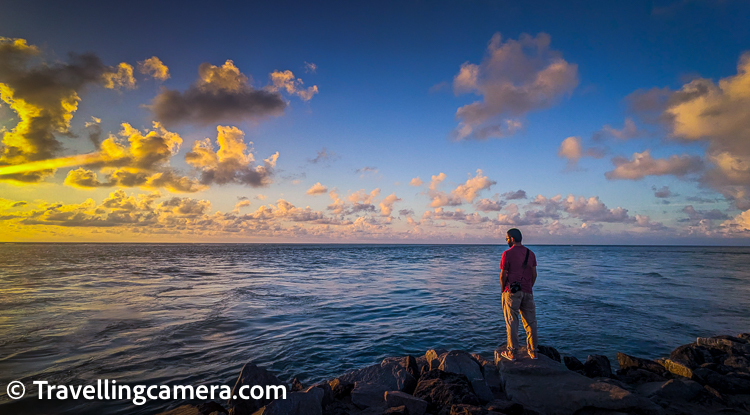
The Bay of Bengal can produce surprisingly clean horizons on clear mornings.
Keep the horizon level.
This sounds obvious, but tilted horizons are particularly noticeable in minimalist seascapes.
4. Use wet sand as a natural mirror
After waves retreat, the wet sand can produce beautiful reflections.
Instead of photographing the temple from eye level, get low.
The combination of reflected architecture and sky can create a much stronger composition.
5. Don't chase every wave
Long exposures can work well when the sea is relatively calm.
But Mahabalipuram's coastline is also excellent for faster shutter speeds that freeze individual wave patterns around rocks.
Look for rhythm rather than simply "motion blur."

Food Along the Mahabalipuram Coast
A coastal trip here should include seafood.
Depending on the restaurant and season, you may find preparations using fish, prawns and other seafood, alongside familiar Tamil dishes.
For breakfast, don't overlook simple South Indian food.
Idli, dosa, vada, pongal and filter coffee are often a better beginning to a photography morning than a heavy meal.
If you have an early sunrise shoot, carry water and have breakfast afterwards. Coastal humidity can make you feel more dehydrated than expected.
The beachside food experience is also part of Mahabalipuram's evening character. Contemporary reports describe beachside shacks and seafood becoming part of the town's night-time atmosphere.
My preference would be to ask locals or your accommodation staff where they themselves eat rather than choosing purely on the basis of the most visible tourist crowd.
Conversations With Local People
One of the most rewarding experiences in Mahabalipuram can happen when you stop trying to "see attractions."
Talk to a sculptor.
Ask a fisherman where his boat goes.
Ask a shopkeeper about the stone sculptures.
Ask a restaurant owner what seafood is fresh that day.
These small conversations can change how you see the town.
The sculptors are particularly interesting because stone carving is not simply an ancient historical activity here. The town still has a strong contemporary stone-carving culture, visible in workshops and roadside sculpture displays.
This creates an unusual continuity.
The same landscape that produced monumental Pallava sculpture centuries ago still has people earning a living from stone.

Hidden Places and Nearby Coastal Experiences
If you have more than a few hours, don't restrict yourself to the main beach.
Tiger Cave
Located north of central Mahabalipuram, Tiger Cave offers a different atmosphere from the busy monument core. It is associated with rock-cut architecture and has a more open, less concentrated setting.
It can work particularly well for photographers who prefer environmental compositions rather than crowded tourist photographs. Tamil Nadu Tourism lists Tiger Caves among the nearby attractions.
Covelong Beach
Covelong, or Kovalam Beach, is another important coastal stop north of Mahabalipuram.
It has developed a stronger surf culture and offers activities such as surfing and kayaking depending on conditions. Tamil Nadu Tourism specifically highlights Covelong's surfing culture and coastal activities.
For a traveller interested in comparing Tamil Nadu beaches, Covelong is useful because it feels different from Mahabalipuram.
Mahabalipuram is strongly associated with heritage and sculpture.
Covelong has a stronger contemporary beach and surf identity.
Sadras
Sadras, farther south, is another coastal option for travellers with extra time. It offers a quieter historical and coastal atmosphere and can be combined with a broader exploration of the ECR.
Best Time to Visit Mahabalipuram Beaches
For most travellers, October to March is the more comfortable period for exploring the coast, particularly if you plan to spend several hours outdoors.
The hotter months can be demanding in the middle of the day.
The monsoon and cyclone season can also bring changing sea conditions, strong winds and interruptions to outdoor plans.
However, there is no single "best" month for every traveller.
| Season | Experience |
|---|---|
| October–November | Greener surroundings, changing weather, possible rain |
| December–February | Pleasant for sightseeing and photography |
| March–May | Hotter, especially midday |
| June–September | Humid, occasional rain and changing coastal conditions |
For photographers, season matters less than time of day.
A mediocre winter afternoon can produce worse photographs than a humid summer morning.
How to Reach Mahabalipuram
The easiest approach is from Chennai via the East Coast Road.
Mahabalipuram is approximately 60 km south of Chennai, and road travel along the ECR is itself part of the experience. Tamil Nadu Tourism lists buses and taxis from Chennai and identifies Chennai as the nearest airport.
From Chennai
Taxi or private car: convenient for photographers carrying equipment.
Bus: economical and practical.
Self-drive: useful if you want to explore Covelong, Tiger Cave and other coastal stops.
From Pondicherry
Mahabalipuram can also be included naturally in a Chennai–Pondicherry coastal road trip.
If photography is your priority, avoid treating the journey as a simple transfer.
The ECR offers opportunities to stop at fishing villages, coastal viewpoints and smaller roadside places.

Where to Stay in Mahabalipuram
There are three broad choices:
Near the beach
Best if you want sunrise access and evening walks.
In the town
Convenient for restaurants, shops, monument access and local life.
Resort properties around the ECR
Better suited to travellers looking for a slower coastal stay, larger rooms and resort facilities.
For photographers, proximity to the beach is often more valuable than luxury.
If you are serious about sunrise photography, being able to walk to the shore in five minutes is far better than spending 30–40 minutes getting there every morning.
Budget Tips
Mahabalipuram can be explored at several budget levels.
| Expense | Budget approach |
|---|---|
| Accommodation | Guesthouse or simple hotel |
| Food | Local South Indian restaurants |
| Transport | Bus + walking + auto |
| Photography | Carry existing equipment; no special activity required |
| Sightseeing | Combine nearby monuments geographically |
| Beach experience | Free and best experienced on foot |
The biggest budget-saving strategy is simple: walk more.
Many central attractions are relatively close to each other, and walking allows you to notice sculpture workshops, small shops, local houses and everyday street life that disappear when travelling continuously by vehicle.
A Suggested 2-Day Mahabalipuram Itinerary
Day 1: Heritage and the Sea
Early morning
Reach Mahabalipuram Beach before sunrise.
Photograph fishermen and the coastline.
Photograph the Shore Temple in changing morning light.
Breakfast
South Indian breakfast and filter coffee.
Late morning
Shore Temple.
Arjuna's Penance.
Krishna Mandapam.
Varaha Cave.
Afternoon
Return to your accommodation and rest.
The midday heat can be intense, especially for photographers carrying heavy equipment.
Evening
Return to the beach.
This time, don't carry the same photographic agenda.
Watch families, vendors, fishermen and the changing colour of the sky.
Day 2: Quieter Mahabalipuram
Morning
Pancha Rathas.
Local sculpture workshops.
Explore quieter lanes.
Late morning
Drive towards Tiger Cave.
Afternoon
Lunch and rest.
Late afternoon
Visit Covelong Beach if you want a contrasting coastal experience.
Evening
Return towards Mahabalipuram or continue along the ECR.
Responsible Travel on the Mahabalipuram Coast
The coastline and monuments need more care than a casual beach visit might suggest.
Remember:
Do not climb protected monuments.
Avoid touching ancient carvings unnecessarily.
Don't leave plastic on the beach.
Don't disturb fishing equipment or boats.
Ask before photographing people closely.
Don't enter restricted archaeological areas.
Avoid walking too close to unstable coastal rocks.
Respect temple customs and dress appropriately around religious spaces.
Don't assume every shell, stone or archaeological-looking object is a souvenir.
The World Heritage property is protected and managed by the Archaeological Survey of India, with designated prohibited and regulated areas around the monuments.
Common Mistakes to Avoid
Arriving only at noon
This is perhaps the biggest mistake.
You miss the best light, the fishing activity and the cooler atmosphere.
Treating Mahabalipuram only as a temple destination
The coastline is essential to understanding the town.
Spending the entire day on the main beach
Explore the surrounding coastal landscape too.
Photographing people without interaction
A photograph becomes more meaningful when the person is treated as a participant rather than scenery.
Underestimating the heat
Carry water, sunscreen and a hat.
Trying to photograph everything
Choose a theme.
One morning focused on fishermen and the sea can produce a much stronger visual story than 300 random photographs of monuments.
Frequently Asked Questions About the Beaches of Mahabalipuram
Is Mahabalipuram Beach worth visiting?
Yes, particularly if you enjoy combining coastal scenery with history, photography and local life. The beach sits beside the Shore Temple and the historic core of Mamallapuram.
Is the Bay of Bengal in Mamallapuram safe for swimming?
Sea conditions vary, and visitors should follow local warnings and lifeguard or authority instructions. The coastline can have waves and currents that are unsuitable for casual swimming. Treat it as a coastal environment first rather than assuming every section is a swimming beach.
What is the best time to visit Mahabalipuram Beach?
Early morning is best for photography, cooler temperatures and fishing activity. December to February is generally more comfortable for extended outdoor exploration.
Can I see sunrise at the Shore Temple?
Yes. The coastline around the Shore Temple is particularly atmospheric around dawn, although access arrangements and monument-entry rules can differ from simply viewing the temple from the surrounding seafront.
Which are the best beaches near Mahabalipuram?
Mahabalipuram Beach is the central coastal experience. Covelong Beach offers a different atmosphere, particularly for surfing and contemporary beach activities. Sadras is another option for travellers exploring farther south.
Is Mahabalipuram good for photography?
Very much so. You can photograph architecture, fishermen, boats, waves, sculpture details, street life and coastal landscapes within a relatively compact area.
What should I photograph at Mahabalipuram Beach?
For a strong photo story, look beyond the obvious Shore Temple. Photograph fishermen preparing boats, wet-sand reflections, waves against granite, sculpture workshops, seafood preparation and the changing relationship between the town and the sea.
How far is Mahabalipuram from Chennai?
Mahabalipuram is roughly 60 km south of Chennai by road, with the East Coast Road being the natural route for most visitors.
Is Mahabalipuram good for a weekend trip?
Yes. Two days are enough to combine the major heritage sites with the beach, photography, local food and one or two nearby coastal destinations.

Final Thoughts: When the Sea Becomes Part of the Monument
The most memorable thing about Mahabalipuram is not a single temple or beach.
It is the relationship between them.
A Pallava temple rises where the land meets the Bay of Bengal. Fishing boats move through the same horizon that ancient traders once knew. Sculptors still work with stone in a town celebrated for masterpieces carved many centuries ago. And every morning, the sea changes the appearance of the monuments simply by changing the light.
That is why I prefer experiencing the Bay of Bengal in Mamallapuram early in the day.
Stand near the water before the crowds arrive.
Listen to the waves.
Watch fishermen begin their work.
Look at the Shore Temple without immediately lifting the camera.
Then take the photograph.
Perhaps that is the best way to experience Mahabalipuram — not as a collection of tourist attractions, but as a living coastal landscape where history, stone, people and the sea continue to share the same frame.
Related Blogposts from Tamilnadu:

Descent of the Ganga River and Arjuna's Penance: Exploring Mahabalipuram Heritage Park

Main Places to Explore in Mahabalipuram: A Complete Guide to Mahabalipuram Tourism in Tamilnadu

Varaha Cave in Mahabalipuram: Exploring a Quiet Masterpiece of the Mamallapuram Heritage Site

Heritage Sites in Mamallapuram, Tamilnadu : Discovering the Unfinished Raya Gopuram

Draupadi’s Bath in Mahabalipuram, Tamilnadu : A Small Rock-Cut Cistern With a Curious Story

Trimurti Rock-Cut Cave Temple in Mahabalipuram, Tamilnadu : A Quiet Pallava Masterpiece

Mamallapur Lighthouse, Tamil Nadu: A Historic Beacon Above the Bay of Bengal

Ramanuja Mandapam in Mahabalipuram, Tamilnadu: A Quiet Chapter of Pallava Heritage

Krishna’s Butter Ball in Mamallapuram Heritage Park, Tamilnadu: The Giant Boulder That Refuses to Roll

Mahishasuramardini Rock Cut Mandapa, Mahabalipuram, Tamilnadu: A Photographer’s Journey Through Pallava Art

Iswara Temple Hillock, Mahabalipuram, Tamilnadu: A Quiet View into the Temples of Tamil Nadu

Shore Temple in Mahabalipuram, Tamilnadu: Where Pallava Stone Meets the Bay of Bengal

An Eventful Hike around Virupaksha Caves and Skand Ashram in Tiruvannamalai, Tamilnadu, India

The magnificent Arunachalesvara Temple, Tiruvannamalai, Tamilnadu || A Shiva Temple with a rich and interesting history

Chennai Travel Guide: The Cultural Capital of South India - Capital Cities of Indian States [Tamilnadu]

The Majestic Brihadeeshwara Temple: A Glimpse into the Architectural Brilliance of Thanjavur in Tamilnadu, India


Unlocking the Treasures of Saraswati Mahal Library in Thanjavur, Tamilnadu || Exploring India's oldest and most fascinating collection of manuscripts

The Magnificence of Cholapuram Temple: A Glimpse into the Ancient Heritage of Tamil Nadu, India

Discovering the Charms of Rameshwaram: Must-Visit Places for Travelers

Embracing the Serenity of Sunrise: Exploring Dhanushkodi in the Early Hours of the Morning | Tamilnadu Diaries

Vellore Fort in Tamilnadu, India : A Living Museum of South Indian Architecture

Exploring the Architectural Marvels and Historical Significance of Arulmigu Ramanathaswamy Temple in Rameshwaram, Tamilnadu : A Spiritual Journey Through Time

Pilgrimage to the Miraculous Churches of Velankanni: Exploring the History, Culture, and Beauty of this Sacred Town

Capturing the Serene Beauty of Sunset around Pamban Bridge in Rameshwaram, Tamilnadu : A Photographer's Delight

Exploring the Rich Fishing Heritage of Rameshwaram: A Journey Through the Bustling Fishermen Town Thangachimadam in Tamilnadu, India

Preserving the Grandeur of Chola Palace in Gangaikondacholapuram: The Role of the Archaeological Survey of India in Ariyalur District of Tamilnadu
Thanjavur Palace in Tamilnadu: Where History and Art Come Together in a Spectacular Display

Auroville in India : The City of Dawn and a Model for Spirituality & Sustainable Living

Ramarpatham Shrine at Rameshwaram, Tamil Nadu || The site that has Lord Ram's footprints sculpted on a rock

The Sacred and Architectural Marvels of Ranganathaswamy Temple in Tamilnadu, India
%20to%20see%20the%20Danish%20fort%20in%20Tamilnadu%20state%20of%20India-3.jpg "Do you know about the 'Danish' Fort in India which is located at a beautiful location round the coast of Bay of Bengal?")
Do you know about the 'Danish' Fort in India which is located at a beautiful location round the coast of Bay of Bengal?

Uncovering the Rich History and Beauty of the Basilica of the Sacred Heart of Jesus in Pondicherry, India
 |
| Anaikarai Dam |
Anaikarai North and South Dams on Kollidam Rivers, Tamil Nadu || Two of the many dams on Cauvery, some of which are nearly 2000 years old

Starting the Day Right: A Personal Reflection on Sunrise at Serenity Beach in Pondicherry, India

Puducherry Travel Guide: French Charm Meets Indian Spirit - Capital Cities of Indian States or Union Teritorries [Pondicherry]

Madanapalle to Thanjavur via Vellore and Tiruvannamalai - 4th day of our 14 days long trip through east coast of India || Noida to Rameshwaram

Thanjavur to Rameshwaram via Tiruchirapalli - 5th day of our 14 days long trip through east coast of India || Noida to Rameshwaram

Rameshwaram's Marine Museum, Harbour and More: A Guide to the Best Sights and Sounds from Tamilnadu State of India
Rameshwaram in Tamilnadu, India - The Land of Sacred Shrines and Mesmerizing Beaches

Villoondi Teertham - Discovering the Spiritual and Natural Wonders of Rameshwaram, India
%20to%20see%20the%20Danish%20fort%20in%20Tamilnadu%20state,%20India-1.jpg "Drive from Rameshwaram to Pondicherry along the coast - 7th day of our 14 days long trip through east coast of India || Noida to Rameshwaram")
Drive from Rameshwaram to Pondicherry along the coast - 7th day of our 14 days long trip through east coast of India || Noida to Rameshwaram

Drive from Pondicherry to Tada - 8th day of our 14 days long trip through east coast of India || Noida to Rameshwaram

Exploring the Mahatma Gandhi Statue and Other Attractions around Promenade Beach in Pondicherry, India

Kolams and Culture: The Significance of Daily Floor Art in Tamilnadu Homes of South India

Healing Waters and Holy Legends: A Visit to Vibhishan Teertham in Rameshwaram, Tamilnadu

Discovering the Mysteries of Sri Panchmukhi Hanuman Mandir and the Floating Stones of Rameshwaram in Tamilnadu
 Climb to the Top of Chennai Lighthouse : Exploring Aerial views of Marine Drive, Sea and other interesting landmarks of Chennai, Tamilnadu


.jpg)
Comments