
Our Lady of Guadalupe at St. Bernard, New York: Exploring One of the Most Meaningful Churches in New York City

Introduction: A Little Piece of Mexico's Spiritual Heritage in Manhattan
Located at 328 West 14th Street in Manhattan, this Roman Catholic church is more than a traditional place of worship. It represents the journey of Spanish-speaking communities in New York, the growing Mexican presence in the city and the enduring devotion to Our Lady of Guadalupe, one of the most beloved religious figures in Mexican culture.
Walking along West 14th Street, it is easy to become absorbed in the neighbourhood's shops, restaurants, traffic and everyday activity. Yet, behind the historic church façade is a quieter world. Inside, the atmosphere changes. The sounds of Manhattan seem to fade, and the experience becomes more personal.
What makes this church particularly interesting is its layered history. The present sanctuary occupies the historic building of St. Bernard's Church, originally established for the Irish Catholic community. However, its identity changed when the nearby Our Lady of Guadalupe parish merged with St. Bernard's in 2003.
Today, the church brings together an older architectural legacy and a vibrant Spanish-speaking Catholic community.
For travellers interested in religious architecture, immigrant history, Mexican culture and lesser-known places in Manhattan, Our Lady of Guadalupe at St. Bernard offers a rewarding experience.

Why Visit Our Lady of Guadalupe at St. Bernard?
There are many beautiful churches in New York City, from the monumental St. Patrick's Cathedral to the historic churches of Greenwich Village. However, not every church offers such an interesting combination of architecture and immigrant heritage.
Here are some reasons to include Our Lady of Guadalupe at St. Bernard in a Manhattan exploration.
A fascinating immigrant history: The church connects the Irish Catholic history of 19th-century Manhattan with the Spanish-speaking communities that shaped the neighbourhood during the 20th century.
Mexican religious traditions: The devotion to Our Lady of Guadalupe makes this an important spiritual centre for Mexican Catholics living in New York.
Historic architecture: The original St. Bernard's building is an impressive example of 19th-century Gothic Revival ecclesiastical architecture.
A living cultural experience: Spanish-language services and religious celebrations make the church an active part of the city's Hispanic community.
A different side of Manhattan: The church offers an opportunity to explore an aspect of New York that is often missed by visitors concentrating on famous landmarks.
Unlike a museum, this is a functioning religious institution. The experience is not simply about observing an old building. It is about understanding how places of worship continue to evolve with the communities around them.
Historical and Cultural Significance of Our Lady of Guadalupe at St. Bernard
To understand the present church, it is important to explore the histories of two separate parishes: St. Bernard's and the original Our Lady of Guadalupe Church.
The history of St. Bernard's Church
The history of St. Bernard's goes back to 1868, when a parish was organised to serve the growing Irish Catholic population of Greenwich Village and Chelsea.
During the second half of the 19th century, New York was experiencing significant immigration. Irish families were establishing themselves in different parts of Manhattan, and churches were important centres of community life.
The original congregation initially worshipped in a converted wagon factory on West 13th Street. As the community expanded, a larger church became necessary.
The present building was designed by Irish-born architect Patrick Charles Keely, one of the most prolific church architects in North America during the 19th century.
Construction began in 1873, and the church was completed in 1875.
Its Gothic Revival architecture reflected the architectural traditions that were popular among Catholic congregations of the period. The church was regarded as an important religious building in Manhattan and became associated with the Irish-American community.
An interesting historical episode occurred in December 1890, when a major fire destroyed much of the church's interior, roof and tower spires.
The congregation did not abandon the building. Reconstruction began, and the church was reopened within a relatively short period. This episode reflects the importance of St. Bernard's to the community that had established it.
The arrival of Our Lady of Guadalupe in New York
The history of Our Lady of Guadalupe in Manhattan began in 1902.
At the turn of the 20th century, Spanish-speaking immigrants were establishing communities in New York. Many came from Spain, particularly Galicia, while others came from Mexico, Puerto Rico, Cuba and different parts of Latin America.
Father Venance, an Assumptionist priest, recognised that these communities needed a church where they could worship in their own language and maintain their religious traditions.
He identified the West 14th Street area as a suitable location because of its concentration of Spanish and Mexican residents.
A brownstone building at 229 West 14th Street was acquired and converted into a chapel dedicated to Our Lady of Guadalupe.
On February 23, 1902, the first altar was established there.
This became New York City's first Catholic parish dedicated to serving the Spanish-speaking community.
The original church was particularly important because it offered immigrants more than religious services. It gave them a familiar cultural environment in a city where language and social barriers could make everyday life difficult.
The connection with Little Spain
The neighbourhood around West 14th Street was once associated with an immigrant enclave known as Little Spain.
Spanish-speaking businesses, social organisations, cultural institutions and religious communities developed in this part of Manhattan.
For Spanish immigrants, the church became a familiar gathering point. It helped preserve cultural traditions and provided a sense of continuity with the lives they had left behind.
Over time, the congregation became increasingly diverse.
Mexican, Puerto Rican and Cuban communities also became part of its religious life.
The church eventually became an important spiritual centre for Spanish-speaking Catholics across New York City.
The 2003 merger: Two histories become one
During the late 20th century, the Mexican population of New York grew considerably.
The original Our Lady of Guadalupe Church was relatively small, and increasing attendance created the need for a larger space.
In 2003, the parish merged with the nearby St. Bernard's parish. Religious activities moved to the larger church building at 328 West 14th Street.
The resulting institution became known as Our Lady of Guadalupe at St. Bernard.
This merger was more than an administrative decision. It brought together two historic Catholic communities.
One had originally served Irish immigrants, while the other had become a spiritual home for Spanish-speaking communities.
Today, the building continues this evolving tradition.
The Religious Significance of Our Lady of Guadalupe
To understand the importance of this church, one must understand the significance of Our Lady of Guadalupe in Mexican culture.
Our Lady of Guadalupe, also known as the Virgin of Guadalupe, is one of the most important religious figures in Mexico and throughout Latin America.
According to Catholic tradition, the Virgin Mary appeared to an Indigenous Mexican man named Juan Diego in December 1531 on Tepeyac Hill, near present-day Mexico City.
The traditional account describes how Juan Diego was asked to convey a message to the local bishop. As a sign, an image of the Virgin appeared on his cloak, known as a tilma.
This image became one of the most recognisable religious symbols in the Americas.
The Basilica of Our Lady of Guadalupe in Mexico City attracts millions of pilgrims every year.
For many Mexicans, devotion to Our Lady of Guadalupe is closely connected with family, cultural identity, hope and national heritage.
This devotion travelled with Mexican migrants to different parts of the world.
In New York, the shrine at St. Bernard provides a place where Mexican families and other Spanish-speaking Catholics can continue these traditions.
December 12, the Feast of Our Lady of Guadalupe, is particularly significant. Celebrations associated with the occasion often include special Masses, prayers, music and traditional expressions of devotion.
For visitors, understanding this background makes a visit to the church much more meaningful.
Exploring the Architecture of Our Lady of Guadalupe at St. Bernard
One of the interesting aspects of this church is that its present architectural identity belongs to the original St. Bernard's building.
Designed by Patrick Charles Keely, the structure reflects the Gothic Revival tradition that influenced many Catholic churches in the United States during the 19th century.
Gothic Revival architecture
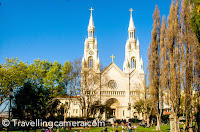
The exterior immediately suggests the architectural ambitions of the period.
Look carefully at the façade, and several characteristic elements become apparent:
Tall vertical proportions.
Gothic-inspired architectural openings.
Twin tower structures.
A prominent central entrance.
Decorative stonework.
A large rose window.
Carefully balanced architectural composition.
The design combines English and French Gothic influences.
Rather than relying on excessive surface decoration, the building uses vertical lines and architectural proportions to create a sense of grandeur.
The towers and pointed architectural details draw the eyes upwards, a characteristic feature of Gothic ecclesiastical architecture.
The historical significance of Patrick Charles Keely
Patrick Charles Keely was an Irish-born architect who designed hundreds of religious buildings across North America.
He worked extensively with Catholic communities, particularly those with Irish roots.
His work included churches, cathedrals and other religious institutions.
St. Bernard's is an interesting example of his architectural approach, combining traditional Gothic influences with the practical requirements of a large urban parish.
For architecture enthusiasts, this makes the building worth examining even before considering its later association with Our Lady of Guadalupe.
The interior atmosphere
The interior of a historic church offers a different experience from its street-facing façade.
Once inside, take time to observe the relationship between the nave, the seating arrangements, the sanctuary and the decorative religious elements.
The high ceiling and traditional church layout create a sense of vertical space.
Look for the stained-glass windows and other details that reveal the building's historical character.
The present interior has evolved over time, so it should not be assumed that every element belongs to the original 1870s design.
For photographers, the combination of architectural geometry, religious artwork and natural light can create interesting compositions.
Our Experience of Exploring This Historic Church
One of the things I find particularly interesting about exploring churches in New York City is how their surroundings often tell a story of their own.
A church that once stood at the centre of an immigrant neighbourhood may now be surrounded by modern apartments, commercial establishments and busy city streets.
Our Lady of Guadalupe at St. Bernard is a good example of this transformation.
West 14th Street is an active part of Manhattan. People move between shops, restaurants, offices and nearby neighbourhoods. There is a constant rhythm to the street.
Against this urban setting, the historic church offers a different architectural scale and atmosphere.
What makes the experience meaningful is knowing that this building has served communities with very different backgrounds.
The original St. Bernard's congregation consisted largely of Irish immigrants and their descendants. Decades later, the building became a spiritual home for Mexican and other Spanish-speaking Catholics.
It is interesting to think about the generations of families who have walked through its doors.
For some, the church represents childhood memories and family traditions. For others, it provides a place to celebrate important religious occasions or simply spend a few quiet moments.
As a traveller, I find such places particularly rewarding because they reveal how a city changes without necessarily losing every connection to its past.
A visit here is not about ticking off another landmark. It is about understanding the people and communities behind the architecture.
Hidden Gems and Lesser-Known Stories
The history around Our Lady of Guadalupe at St. Bernard becomes even more interesting when one looks beyond the present church.
1. The original Our Lady of Guadalupe Church is just a short walk away
One of the most interesting details is that the original church building still exists at 229–231 West 14th Street.
It is located only a few hundred feet east of the present shrine.
The original church was created by combining two mid-19th-century residential brownstones.
Its distinctive Spanish Colonial Baroque façade was added in 1921 and designed by architect Gustave Steinback.
This building offers a fascinating contrast with the Gothic Revival architecture of St. Bernard's.
One church represents the architectural traditions of a predominantly Irish Catholic congregation, while the other reflects the cultural aspirations of a Spanish-speaking immigrant community.
The original building is no longer the active parish church, so visitors should distinguish it from the present shrine.
2. Dorothy Day and the Catholic Worker movement
The original Our Lady of Guadalupe parish also has an interesting connection with Dorothy Day.
Dorothy Day was an American Catholic social activist who co-founded the Catholic Worker movement with Peter Maurin.
The movement became known for its commitment to social justice, voluntary poverty and helping people experiencing homelessness.
The original Guadalupe church was part of the spiritual life of Dorothy Day.
The church's association with her is a reminder that its importance extended beyond the Spanish-speaking congregation.
It was also connected with people who viewed faith as a foundation for service and social responsibility.
3. The church once offered practical support to immigrants
The early parish was not limited to religious activities.
A community initiative known as Casa Maria Lopez offered educational and vocational opportunities.
Subjects included typing, bookkeeping, shorthand, music and other practical skills.
Students were encouraged to contribute whatever they could afford, and teachers often donated their services.
This is an important but less widely known aspect of the church's history.
For immigrants adjusting to life in a new country, access to education and practical skills could make a significant difference.
The church therefore functioned as a community support system as well as a religious institution.
4. A neighbourhood shaped by changing immigrant communities
Little Spain was once a significant cultural presence around West 14th Street.
However, immigration patterns and the demographics of Manhattan changed over time.
As Spanish-speaking communities moved or expanded into other parts of New York, new immigrant groups arrived.
The growing Mexican community eventually became an important part of the church's identity.
This evolution makes the area an interesting place to explore if you enjoy understanding the relationship between migration, neighbourhoods and urban history.
5. The original building has an uncertain preservation story
The original Our Lady of Guadalupe Church at 229–231 West 14th Street has also become the subject of preservation efforts.
Local preservation organisations have campaigned for recognition of its architectural and cultural significance.
The discussion is important because the building represents an early chapter of Spanish-speaking immigrant history in New York.
It is a reminder that historic places are not always preserved simply because they have an interesting past.
Their future often depends on public awareness, community involvement and preservation decisions.
Best Photography Spots at Our Lady of Guadalupe at St. Bernard
For photographers interested in architectural photography, the church offers several opportunities.
It is particularly interesting because it sits within a busy Manhattan streetscape.
1. The main façade from across West 14th Street
This is the obvious starting point.
Step back to capture the overall composition of the church.
Try to include both towers and the main entrance rather than photographing only the central doorway.
A slightly wider perspective can help communicate the building's scale within the surrounding streetscape.
2. Architectural details around the entrance
The main entrance offers opportunities for close-up compositions.
Look for the stonework, pointed arches, doors and decorative details.
These photographs can work particularly well in a collection about historic churches in New York City.
3. The towers and upper façade
A wide-angle lens can help capture the vertical proportions of the structure.
However, avoid standing too close to the building because this can create excessive perspective distortion.
Move across the street and experiment with different focal lengths.
4. Interior architectural compositions
If photography is permitted, the interior offers opportunities to capture the nave, stained glass, sanctuary and religious details.
A symmetrical composition from the rear of the church may work particularly well.
However, avoid photographing people during prayer or religious services without permission.
5. The original Our Lady of Guadalupe building
The former church at 229–231 West 14th Street offers a completely different photographic subject.
Its Spanish Colonial Baroque façade provides a visual contrast with the Gothic Revival architecture of St. Bernard's.
Photographing both buildings together in a short walking exploration helps document the evolution of the parish.
Photography Tips for Visiting This Church
Photographing churches in Manhattan requires a little planning because the surrounding streets can be crowded and the buildings are often positioned close to neighbouring structures.
Here are some useful suggestions.
| Photography aspect | Recommendation |
|---|---|
| Best exterior timing | Early morning |
| Best natural light | Soft morning light |
| Best street photography | Late morning or afternoon |
| Lens | 16–35mm or 24–70mm |
| Architectural details | 50mm or short telephoto |
| Interior photography | Check permission first |
| Best composition | Symmetrical façade and vertical perspective |
| Tripod | Avoid blocking the entrance or pedestrian movement |
Photographing the church in different lighting conditions
Early morning: This is generally the best time for exterior photography. Streets are comparatively quieter, and the softer light can help reveal architectural details without harsh shadows.
Midday: Strong sunlight can create contrast between the stonework and darker architectural recesses. Look for interesting shadow patterns rather than attempting to photograph the entire façade in flat light.
Late afternoon: Depending on the season and weather, softer directional light may create attractive textures on the exterior.
Evening: The surrounding streetlights and illuminated windows can produce interesting urban compositions. However, check the actual lighting conditions before planning an evening photography session.
A suggestion for architecture enthusiasts
Try photographing both churches using similar framing.
The present shrine at St. Bernard and the original Guadalupe building represent two different architectural traditions.
A side-by-side comparison can become an interesting visual story about how immigrant communities created places of worship in New York.
Local Food Experiences Around the Church
One of the enjoyable aspects of exploring this part of Manhattan is that the church is surrounded by an interesting food scene.
Although the neighbourhood is no longer the historic Little Spain of the early 20th century, West 14th Street and the surrounding Chelsea and Greenwich Village areas offer plenty of opportunities for a food break.
Mexican food and the church community
The Mexican connection is an important part of the shrine's contemporary identity.
Religious celebrations associated with Our Lady of Guadalupe often bring together families and communities, and food naturally becomes part of the social experience.
Traditional Mexican foods such as tamales, tacos, churros and sweet breads are closely associated with celebrations in Mexican communities.
If visiting during December's Guadalupe celebrations, look out for opportunities to experience the food traditions associated with the occasion.
However, do not assume that food stalls or vendors will be present every day.
Exploring Chelsea and the surrounding streets
For everyday dining, explore the surrounding Chelsea neighbourhood.
You will find cafés, bakeries, casual restaurants and different international cuisines.
A particularly interesting option is to combine the church visit with a walk towards the Chelsea Market area.
This gives you an opportunity to experience a different side of Manhattan's food culture.
Rather than rushing between famous restaurants, spend some time observing how local residents use neighbourhood cafés and food establishments.
Local Conversations and Human Stories
The most meaningful part of visiting a community church is often the opportunity to understand its relationship with local people.
Places such as Our Lady of Guadalupe at St. Bernard are important because they continue to serve communities whose experiences are not always represented in conventional travel narratives.
For Mexican immigrants, the Virgin of Guadalupe represents a familiar religious and cultural connection.
For families who have lived in New York for generations, the church can be a place where important family traditions continue.
For newcomers, it may offer a familiar language, a community network and a sense of belonging.
The history of the church also demonstrates how immigrant communities contribute to the identity of New York.
Irish Catholics helped establish St. Bernard's in the 19th century. Spanish-speaking immigrants established Our Lady of Guadalupe in the early 20th century. Later, Mexican communities helped give the combined parish its contemporary character.
These stories are worth remembering when exploring churches in the USA.
The architecture may attract visitors, but the people are what keep these buildings meaningful.
If you happen to meet parishioners, approach conversations respectfully. Ask about the church's traditions only when people seem comfortable talking.
A simple conversation can sometimes reveal more about a neighbourhood than an entire afternoon of sightseeing.
Best Time to Visit Our Lady of Guadalupe at St. Bernard
The church can be visited throughout the year, but different seasons offer different experiences.
Spring: March to May
Spring is a pleasant season for exploring Manhattan on foot.
Temperatures are generally comfortable, and the surrounding neighbourhoods become more enjoyable for photography and walking.
This is a good time to combine the church with Greenwich Village and Chelsea.
Summer: June to August
Summer brings longer daylight hours and a lively street atmosphere.
However, Manhattan can become hot and humid.
Plan your visit earlier in the day, especially if you intend to explore several churches or architectural landmarks on foot.
Autumn: September to November
Autumn is one of the most enjoyable seasons for exploring New York City.
The weather is generally suitable for walking, and the changing light can be beautiful for architectural photography.
October and early November are particularly good months for a neighbourhood exploration.
Winter: December to February
December is especially meaningful for this church because the Feast of Our Lady of Guadalupe falls on December 12.
This is an important occasion for Mexican Catholics, and the shrine may host special religious celebrations.
The period around Christmas can also provide an opportunity to experience traditional Catholic decorations and religious observances.
Keep in mind that special events may attract larger congregations, so arrive early and respect the church's arrangements.
How to Reach Our Lady of Guadalupe at St. Bernard
The church is located at:
It is situated between Eighth and Ninth Avenues in the Chelsea and Greenwich Village area.
By subway
The subway is one of the most convenient ways to reach the church.
Nearby stations include:
14 Street on the A, C and E lines.
14 Street on the 1, 2 and 3 lines, with access depending on the entrance and route.
14 Street–Eighth Avenue on the L line.
Check the subway route from your starting point because some stations and exits are more convenient than others.
By bus
Several Manhattan bus routes operate around the 14th Street corridor.
Local bus services can be useful if you are travelling from nearby neighbourhoods.
By taxi or ride-hailing service
Taxis and ride-hailing services can drop visitors near the church entrance.
However, traffic around 14th Street can be unpredictable, particularly during busy commuting hours.
On foot
Walking is one of the best ways to explore the area.
The church can easily be included in a walking itinerary covering Chelsea, Greenwich Village, the High Line and nearby cultural attractions.
Where to Stay Near Our Lady of Guadalupe at St. Bernard
Chelsea and Greenwich Village are convenient areas for visitors who want to explore this part of Manhattan.
They offer access to restaurants, subway stations, museums, shopping areas and several architectural attractions.
Accommodation options vary considerably depending on the season.
You can consider:
Chelsea: A practical base for exploring the church, Chelsea Market, the High Line and nearby neighbourhoods.
Greenwich Village: Suitable for travellers who enjoy historic streets, independent cafés, restaurants and a more residential Manhattan atmosphere.
Meatpacking District: An option for those interested in contemporary restaurants, nightlife, shopping and the High Line.
Midtown Manhattan: Worth considering if you want easy access to other major New York attractions and a wider range of accommodation choices.
New York hotel prices can vary significantly, so compare accommodation costs and subway connectivity before booking.
Staying a little farther away but close to a convenient subway station can sometimes offer better value.
Budget Tips for Visiting Our Lady of Guadalupe at St. Bernard
One advantage of exploring historic churches in New York City is that many can be appreciated without paying an admission fee.
Our Lady of Guadalupe at St. Bernard is a functioning place of worship, not a ticketed tourist attraction.
Here are some ways to keep your visit economical:
Plan your journey using the subway rather than taking taxis.
Combine the church with nearby attractions to make the most of your transportation expense.
Explore neighbourhood cafés and casual food establishments rather than choosing expensive restaurants.
Carry a reusable water bottle.
Check whether special religious celebrations or community events are taking place.
Avoid paying for guided tours unless you specifically want a detailed architectural or historical experience.
Is there an entry fee?
There is generally no admission ticket for entering the church for personal prayer or a respectful visit. Donations are welcome, but visitors should confirm any special event arrangements.
Suggested Itinerary: Exploring Our Lady of Guadalupe and Chelsea
A visit to the church can become part of a larger Manhattan walking exploration.
Here is a suggested half-day itinerary.
| Time | Place | Suggested experience |
|---|---|---|
| 9:00 AM | Our Lady of Guadalupe at St. Bernard | Explore the church exterior and, if permitted, the interior |
| 9:30 AM | Original Our Lady of Guadalupe Church | Observe the historic Spanish Baroque façade |
| 10:00 AM | West 14th Street | Explore the surrounding neighbourhood |
| 10:30 AM | Chelsea Market | Enjoy food and explore the market |
| 11:30 AM | High Line | Walk along the elevated park |
| 12:30 PM | Little Island | Explore the waterfront landscape |
| 1:30 PM | Meatpacking District | Enjoy lunch or coffee |
This itinerary is particularly suitable for visitors who enjoy combining architecture, history, photography and food.
You can also extend the walk towards Greenwich Village if you have additional time.
Responsible Travel Tips for Visiting Churches in New York City
Churches are living religious spaces, and visitors should approach them with respect.
Here are some simple guidelines:
Maintain silence or speak softly inside the church.
Avoid interrupting Mass, prayer or religious ceremonies.
Check photography rules before taking pictures indoors.
Never photograph worshippers without their permission.
Dress respectfully.
Avoid blocking entrances, aisles or seating areas.
Follow instructions from church staff and volunteers.
Do not touch religious objects or artwork unless explicitly permitted.
If attending Mass, observe the congregation's practices and avoid participating in religious rites unless appropriate.
Be particularly considerate during December 12 celebrations, when the church may be busy.
Remember that this is primarily a place of worship. Its importance to the local community comes before its value as a tourist attraction.
Common Mistakes to Avoid When Visiting Our Lady of Guadalupe at St. Bernard
A few small mistakes can make the experience less rewarding.
1. Confusing the present shrine with the original church
The present shrine is located at 328 West 14th Street. The original Our Lady of Guadalupe building is at 229–231 West 14th Street. Both are historically important, but they are separate buildings.
2. Assuming the architecture belongs to the original Guadalupe parish
The present church building was originally St. Bernard's and was constructed in the 1870s. Its architectural history predates the merger with Our Lady of Guadalupe.
3. Visiting only for photographs
The church has a meaningful religious and cultural identity. Take time to understand its history rather than treating it simply as an architectural subject.
4. Visiting during Mass without checking the schedule
If you want to explore the interior quietly, consider visiting outside service times.
5. Expecting a large tourist attraction
This is not a museum or a major sightseeing complex. Its value lies in its architecture, history and living community.
6. Ignoring the original church building
The former Our Lady of Guadalupe Church is one of the most interesting nearby historical sites. Including it makes the visit more informative.
Frequently Asked Questions About Our Lady of Guadalupe at St. Bernard
1. Where is Our Lady of Guadalupe at St. Bernard located?
Our Lady of Guadalupe at St. Bernard is located at 328 West 14th Street, Manhattan, New York 10014, between Eighth and Ninth Avenues.
2. Is Our Lady of Guadalupe at St. Bernard one of the historic churches in New York City?
Yes. The building was originally constructed as St. Bernard's Church between 1873 and 1875. It later became the home of the merged Our Lady of Guadalupe and St. Bernard parish in 2003.
3. What is the significance of Our Lady of Guadalupe?
Our Lady of Guadalupe is one of the most important religious figures in Mexican Catholic tradition. According to Catholic tradition, the Virgin Mary appeared to Juan Diego in 1531 near Mexico City. Her image became an enduring symbol of Mexican faith and cultural identity.
4. When was the original Our Lady of Guadalupe Church established in New York?
The original Our Lady of Guadalupe parish was established in 1902. It was the first Catholic parish in New York City dedicated to serving the Spanish-speaking population.
5. Why did Our Lady of Guadalupe move to St. Bernard's Church?
The original church became too small to accommodate the growing congregation, particularly as the Mexican population in New York increased. The parish merged with St. Bernard's in 2003 and moved to the larger building.
6. Can tourists visit Our Lady of Guadalupe at St. Bernard?
Yes. Visitors can generally enter the church for prayer or quiet observation, subject to service schedules and parish arrangements. Respectful behaviour is expected.
7. Is there an entry fee to visit the church?
There is generally no admission fee for visiting the church. Donations are welcome.
8. What is the architectural style of St. Bernard's Church?
The building is an example of Gothic Revival ecclesiastical architecture, combining English and French Gothic influences. It was designed by architect Patrick Charles Keely.
9. Where is the original Our Lady of Guadalupe Church?
The original church is located at 229–231 West 14th Street, only a short walk east of the present shrine.
10. Is the original Our Lady of Guadalupe Church still active?
No. The parish's religious activities moved to St. Bernard's in 2003. The original building is no longer the active parish church and has been the subject of local preservation efforts.
11. What is the best time to visit Our Lady of Guadalupe at St. Bernard?
Early morning is generally a good time for a quiet exterior visit and architectural photography. December 12 is particularly significant because it is the Feast of Our Lady of Guadalupe.
12. What is the nearest subway station?
The 14 Street stations serving the A, C, E, 1, 2, 3 and L lines provide access to the area. The most convenient station depends on your route and subway service.
13. Are there other churches worth visiting nearby?
Yes. Manhattan has several historically significant churches. You can explore churches in Greenwich Village, Chelsea and the surrounding areas as part of a broader architectural walking tour.
14. Why is this church important to the Mexican community in New York?
The shrine provides a place for Mexican Catholics to maintain their devotion to Our Lady of Guadalupe and celebrate religious traditions. It also serves the wider Spanish-speaking Catholic community.
15. Is Our Lady of Guadalupe at St. Bernard worth visiting?
If you enjoy exploring religious architecture, immigrant history and cultural heritage, this church offers an interesting perspective on New York City. Its significance goes beyond its architecture because it represents the changing communities that have shaped Manhattan.
Final Thoughts: A Church That Reflects the Changing Identity of New York
Exploring Our Lady of Guadalupe at St. Bernard offers a different perspective on New York City.
The building's Gothic Revival architecture recalls a period when Irish immigrants were establishing their communities in Manhattan. Its present identity reflects the growth and cultural contribution of Spanish-speaking communities, particularly Mexicans.
The story becomes even more interesting when we consider the original Our Lady of Guadalupe Church just a short walk away. Together, these two buildings reveal how immigrant communities created spaces that helped them preserve their traditions and establish a sense of belonging in a new country.
For me, this is what makes exploring historic churches in New York City so rewarding. They are not simply architectural landmarks. They are records of human movement, cultural exchange, faith and the passage of generations.
New York is often described through its famous skyline, museums, shopping districts and entertainment attractions. But its identity is equally connected to the neighbourhood institutions that have quietly served communities for decades.
Our Lady of Guadalupe at St. Bernard is one such place.
Whether you visit as a photographer, architecture enthusiast, cultural explorer or simply someone curious about the city's history, it offers an opportunity to discover a more personal side of Manhattan.
And perhaps that is the most interesting part of travelling: finding meaningful stories in places that are not always on the usual tourist itinerary.
Related Blogposts -

Cathedral of Learning, Pittsburgh: Exploring One of the Most Remarkable Universities in Pittsburgh

The Vessel at Hudson Yards, New York: Exploring One of the Most Interesting Buildings in New York City, USA

Little Island in New York: Exploring One of the Most Unusual Places to See in New York, USA

Roberto Clemente Bridge, Pittsburgh: Exploring One of the Most Beautiful Bridges of Pittsburgh

Times Square, New York: Experiencing the Hustle Bustle of New York City, USA




















Comments