A short but rewarding visit to the Khichan Bird Sanctuary || How the local population of a place has made this town a safe haven for the Demoiselle cranes

On our way from Bikaner to Jaisalmer, Khichan Bird Sanctuary was our second scheduled stop after Bap Village. And we were really excited about it. Both of us love watching and Photographing birds and we never miss a chance to visit a bird sanctuary. So this would be the ideal spot for us to take a break and stretch our legs.

On our way from Bikaner to Jaisalmer, Khichan Bird Sanctuary was our second scheduled stop after Bap Village. And we were really excited about it. Both of us love watching and Photographing birds and we never miss a chance to visit a bird sanctuary. So this would be the ideal spot for us to take a break and stretch our legs. 

When there are migratory birds around, you usually see them from a distance. And in this case too, we could see some large birds flying about in V formation. From a distance, we could not identify them, but we were eager to get there.

When there are migratory birds around, you usually see them from a distance. And in this case too, we could see some large birds flying about in V formation. From a distance, we could not identify them, but we were eager to get there. 

When we reached Khichan village, even though it was later in the morning than Bhap, the village was sleepier than Bhap. We reached the fenced area around a small waterbody that was the bird sanctuary, according to a board, and hoped to click some quick photos of the birds and then be off. However, when we reached there, we could only see one red-wattled lapwing and one black-winged stilt to be seen.

When we reached Khichan village, even though it was later in the morning than Bhap, the village was sleepier than Bhap. We reached the fenced area around a small waterbody that was the bird sanctuary, according to a board, and hoped to click some quick photos of the birds and then be off. However, when we reached there, we could only see one red-wattled lapwing and one black-winged stilt to be seen. 

And a couple of dogs were headed straight towards us. And at a brisk pace. We stood still as they approached. Even though I like dogs, Vijay is better at handling strays. So I was really nervous. The dogs were really close now and it was too late to do anything. They reached us and then passed without even throwing us a glance. To be honest, it was a bit of an anticlimax and we felt a little rejected as well.

And a couple of dogs were headed straight towards us. And at a brisk pace. We stood still as they approached. Even though I like dogs, Vijay is better at handling strays. So I was really nervous. The dogs were really close now and it was too late to do anything. They reached us and then passed without even throwing us a glance. To be honest, it was a bit of an anticlimax and we felt a little rejected as well. 

We thought that the birds aren't here yet and may be we are too early in the season. So we started clicking what we could of the water reservoir. In the meanwhile, a couple of local kids skipped up to us and the younger one of the two started talking immediately. "Yeh Mangolia se aati hain. Agar inko bajra daloge to yeh ekdum paas aa jaati hain." He kept repeating these and a few other sentences on a loop.

We thought that the birds aren't here yet and may be we are too early in the season. So we started clicking what we could of the water reservoir. In the meanwhile, a couple of local kids skipped up to us and the younger one of the two started talking immediately. "Yeh Mangolia se aati hain. Agar inko bajra daloge to yeh ekdum paas aa jaati hain." He kept repeating these and a few other sentences on a loop. 

We thought that may be he was talking about the pigeons or the sparrows but were not sure why he kept saying that they come from Mangolia. This was too specific to be wrong. So we asked him what he was talking about.

We thought that may be he was talking about the pigeons or the sparrows but were not sure why he kept saying that they come from Mangolia. This was too specific to be wrong. So we asked him what he was talking about.
  
He pointed to a sandy hill and said "woh chidiyaan". We were confused and so we double-confirmed "wahan chidiyan hain". He said "haan". And we started walking towards the hill, with the children on our heels.

He pointed to a sandy hill and said "woh chidiyaan". We were confused and so we double-confirmed "wahan chidiyan hain". He said "haan". And we started walking towards the hill, with the children on our heels. 

Before we could reach the hill we heard a weird squawking sound. And then a flock of large birds emerged from behind the hill, flying in V formation. It was the most amazing moment. Take a couple of minutes to be in this moment with us...

Before we could reach the hill we heard a weird squawking sound. And then a flock of large birds emerged from behind the hill, flying in V formation. It was the most amazing moment. Take a couple of minutes to be in this moment with us...

The voice inside me told me that these were the Demoiselle Cranes. The rare and pretty birds that indeed fly to India from Mangolia were on my "must see" list and I did not know that I would get to check these off during this trip.

The voice inside me told me that these were the Demoiselle Cranes. The rare and pretty birds that indeed fly to India from Mangolia were on my "must see" list and I did not know that I would get to check these off during this trip. 

Once we were over the hill (literally, not figuratively) we came across the sight that we had hoped we would see. Hundreds of Demoiselle cranes were pecking the grains that locals had spread for them. And they were a sight to behold.

Once we were over the hill (literally, not figuratively) we came across the sight that we had hoped we would see. Hundreds of Demoiselle cranes were pecking the grains that locals had spread for them. And they were a sight to behold. 

Demoiselle Cranes (grus virgo) are a species of crane that breed in central Eurosiberia, ranging from Black Sea and Mangolia to North Eastern China, plus a small breeding population in Turkey. The birds fly south to Africa and Indian subcontinent to spend the winter months.

Demoiselle Cranes (grus virgo) are a species of crane that breed in central Eurosiberia, ranging from Black Sea and Mangolia to North Eastern China, plus a small breeding population in Turkey. The birds fly south to Africa and Indian subcontinent to spend the winter months. 

So practically they split their time half and half in both the areas. Then why do we say that these are siberian birds that visit India. They can also be Indian birds that visit Siberia to breed. Can't they?

So practically they split their time half and half in both the areas. Then why do we say that these are siberian birds that visit India. They can also be Indian birds that visit Siberia to breed. Can't they?   

At 76 cm tall, Demoiselles are the smallest birds in the crane family. They are also tall and slender and delicate looking birds that often symbolize beauty and fragility. They are predominantly gray in color with black neck and head and a white stripe running from their eyes all the way to the back of their head.

At 76 cm tall, Demoiselles are the smallest birds in the crane family. They are also tall and slender and delicate looking birds that often symbolize beauty and fragility. They are predominantly gray in color with black neck and head and a white stripe running from their eyes all the way to the back of their head. 

The birds fly in a V formation, like most other birds that are used to migrating over large distances. The V formation is headed by a female with two sub-adults flying on either side of her and the males make up the rear of the formation.

The birds fly in a V formation, like most other birds that are used to migrating over large distances. The V formation is headed by a female with two sub-adults flying on either side of her and the males make up the rear of the formation. 

Demoiselle cranes take a very hard migratory path each way. They fly at a really high altitude at about 16,000 - 26,000 feet. They cross the Himalayas twice every year and many die because of hunger, starvations, tiredness, or fall prey to predators like the Golden Eagle.

Demoiselle cranes take a very hard migratory path each way. They fly at a really high altitude at about 16,000 - 26,000 feet. They cross the Himalayas twice every year and many die because of hunger, starvations, tiredness, or fall prey to predators like the Golden Eagle. 

The birds are known as koonj or kurjan in North Indian languages. In Sanskrit, the birds are known as kranch. In fact it is the demoiselle crane that is credited with being the source of inspiration for the first metered verse.

The birds are known as koonj or kurjan in North Indian languages. In Sanskrit, the birds are known as kranch. In fact it is the demoiselle crane that is credited with being the source of inspiration for the first metered verse. 

As per Indian mythology, when Valmiki witnessed the lament of a female demoiselle crane whose mate had been killed by a hunter, he cursed the hunter in a verse that spontaneously came to him.

As per Indian mythology, when Valmiki witnessed the lament of a female demoiselle crane whose mate had been killed by a hunter, he cursed the hunter in a verse that spontaneously came to him. 

There is also a mention of kraunch in Mahabharat. On the second day of the Kurukshetra war, it is written in some texts that both the sides arranged their troops in kraunch formation. It was thought to be an effective troop formation.

There is also a mention of kraunch in Mahabharat. On the second day of the Kurukshetra war, it is written in some texts that both the sides arranged their troops in kraunch formation. It was thought to be an effective troop formation.  

The demoiselle crane was so named by Queen Marie Antoinette for its delicate and maiden-like appearance. Demoiselle crane's local names in Urdu (Koonj) and in Pashto (Zaanray) both mean a beautiful person. And the crane is marked Least Concern in the IUCN Red List of Threatened Species.

The demoiselle crane was so named by Queen Marie Antoinette for its delicate and maiden-like appearance. Demoiselle crane's local names in Urdu (Koonj) and in Pashto (Zaanray) both mean a beautiful person. And the crane is marked Least Concern in the IUCN Red List of Threatened Species.  

The story of why Demoiselle cranes started landing in Khichan is also very interesting. In the 1970s, Ratanlal Maloo, a native of Khichan and a devout Jain, started spreading the grains on the ground for birds. A number of pigeons, sparrows and squirrels started coming to the place; peacocks also occasionally visited the place to feed on the grains.

The story of why Demoiselle cranes started landing in Khichan is also very interesting. In the 1970s, Ratanlal Maloo, a native of Khichan and a devout Jain, started spreading the grains on the ground for birds. A number of pigeons, sparrows and squirrels started coming to the place; peacocks also occasionally visited the place to feed on the grains. 

Then in September that year, a few demoiselle cranes also joined the other birds. During September-February, around 100 cranes came to the feeding place. And then in the next winter, around 150 cranes visited the place. As the cranes grew in numbers, the local dogs started hunting them. So, Ratan Lal asked the village panchayat to allot him some land on the outskirts of the village. Villagers built a chugga ghar ("bird feeding home"), with a granary and a fence. Several Jain traders supported the initiative by supplying grains.

Then in September that year, a few demoiselle cranes also joined the other birds. During September-February, around 100 cranes came to the feeding place. And then in the next winter, around 150 cranes visited the place. As the cranes grew in numbers, the local dogs started hunting them. So, Ratan Lal asked the village panchayat to allot him some land on the outskirts of the village. Villagers built a chugga ghar ("bird feeding home"), with a granary and a fence. Several Jain traders supported the initiative by supplying grains.
 
What started initially as a few dozen visiting birds has now become a major migration with thousands of cranes visiting the village year after year, during the period of August to March, and the number is reported to be increasing. This is attributed to the feeding done by the village community, twice a day during the birds entire stay in the town.  After watching the cranes for some time and clicking pictures, we bought the two kids some packets of chips from a local shop and headed onward toward Jaisalmer. Overall this had been a really good stop.

What started initially as a few dozen visiting birds has now become a major migration with thousands of cranes visiting the village year after year, during the period of August to March, and the number is reported to be increasing. This is attributed to the feeding done by the village community, twice a day during the birds entire stay in the town.

After watching the cranes for some time and clicking pictures, we bought the two kids some packets of chips from a local shop and headed onward toward Jaisalmer. Overall this had been a really good stop. 

Related Blogposts - 

Demoiselle Cranes (grus virgo) are a species of crane that breed in central Eurosiberia, ranging from Black Sea and Mangolia to North Eastern China, plus a small breeding population in Turkey. The birds fly south to Africa and Indian subcontinent to spend the winter months.

Demoiselle cranes of Khichan, Jodhpur District, Rajasthan || Beautiful Birds that fly to and fro Mangolia and have found a mention in Indian mythological texts
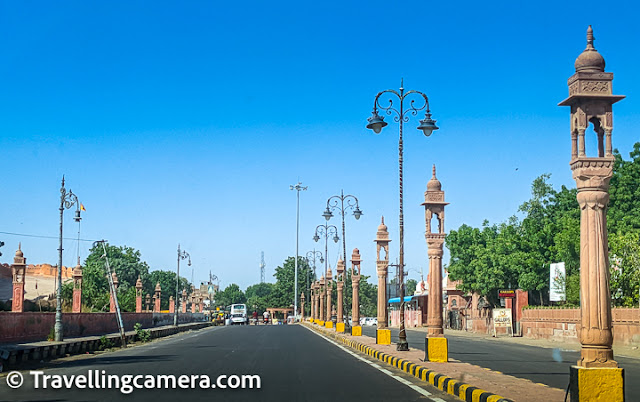
The locals in Bikaner refer to themselves as being "saral, sukh, and sust". One of my good friends from Bikaner shared that people in Bikaner take pride in acknowledging that they are content. So I guess it is true. The state of the traffic on the roads does reflect the pace of life.


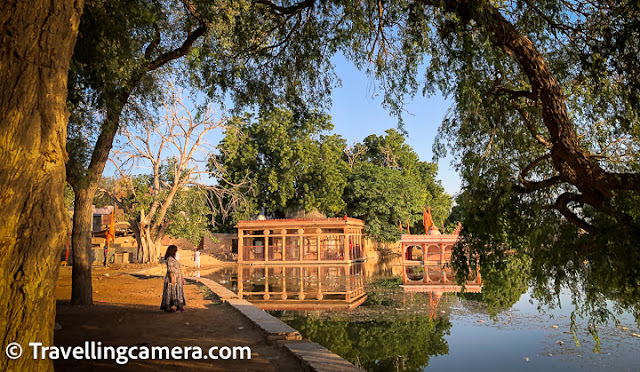
However, we did spot some migratory birds flying around and were sure that there is probably a water body around. We decided to explore that. After asking around a little we reached a lake of humungous proportions and there was a temple on the shore. There was a man offering prayers in the temple and while we were roaming around, he caught up to us and started asking us some questions.


Even though we had been warned against booking a hotel in old Bikaner, because the roads are congested, we managed to find the perfect hotel - Hotel Jaswant Bhawan - which is perfectly located at the edge of old Bikaner with approach via wide roads and a spacious parking. And it was just walking distance from most of the places in old Bikaner.


Rampuria havelis are a group of 15th century opulent havelis that stand out in the labyrinthine roads of old Bikaner. While these havelis are symbols of wealth and luxurious lifestyles of rich merchants of Bikaner, they are surrounded by the comparatively modest homes of the middle class business people.


While travelling from Laxmangarh to Bikaner on Agra-Bikaner Highway, you will notice some chhatris on your left. When you do so, stop your car, get down for a bit, and stretch your legs. For this is a heritage site that you may want to capture in your camera.

If you are in Udaipur and have to chose only one place to visit & explore, City Palace has to be that place. Certainly there can be personal choices as for someone visiting a particular restaurant for a meal or take a walk around ghat of Lake Pichola is more important than the City Palace. In this blogpost we will share about why City Palace was a special place for us and what all you see inside this beautiful palace.  First photograph of this post is clicked by our guide who helped us explore Udaipur City Palace.

Related Blogposts -

As winter approaches North India, various wetlands start seeing thousands of Migratory Birds and Bharatpur's Keoladeo Bird Sanctuary is one of the most popular wetlands around National Capital region of India and hence sees lot of tourists from Delhi/Noida/Gurgaon region. And it's not limited to nearby tourists. Lot of serious birders visit Bharatpur during Winters from various parts of the country as well as foreigner tourists. This blog-post shares tips to plan a successful trip to Bharatpur from Delhi and what kind of things to take care while planning this birding trip. One day Road-Trip to Bharatpur Birds Sanctuary from Delhi : Winters Special


We were definitely fortunate when it comes to the number of Herons and Egrets we were able to sight during our visit to the Keoladeo National Park in November. However, at that time, we did not know which was which. These two birds are so similar when it comes to their behavior that it takes an expert to identify them separately. We referred to our birding companion - A Pictorial Field Guide to Birds of India. However, I am sure we have made some mistakes in case of a few birds. In case you can spot any, please do point them out. We would be eternally grateful. Great Egrets.Both Herons and Egrets, and also the Bitterns, belong to the family Ardeidae. Though some argue that these are actually same birds with the only differences being that Egrets usually have white or buff plumage and develop distinctive white plumes during the breeding season. Otherwise, both these birds seek the same kind of habitat - wetlands. They breed in trees close to the wetlands, and they fly with their necks retracted, unlike storks and cranes who fly with their necks outstretched. Grey Heron in Flight. Experts are still undecided about what makes a heron, a heron and an egret, an egret. So much so that though these birds are classified under separate genera - Ardea and Egretta - the only marked difference in the definition of  these genera is the size. Ardea consists of larger of the Herons whereas Egretta consists of the smaller ones. Though the size difference is often indistinct. Both the birds typically have a large wingspan and look very graceful in flight. Great Egret in Flight. You will often see these birds standing still with one leg raised and their necks outstretched carefully watching out for prey to come close enough so that they can snap it up with a quick movement of their neck and beaks. These birds are carnivorous and feed mainly on fish, frogs, lizards, and molluscs. Some herons, such as the cattle egret, often move away from the wetlands and follow cattle. These egrets feed on the insects that are disturbed by the movement of cattle in bushes. Juvenile Purple Heron(?) in the foreground with Great Egrets in the Distance. Another aspect that is unique about Herons is that they have powder down. These peculiar down feathers that often disintegrate into a powdery substance are thought to be of special significance to these birds because of their wet habitat and damp surroundings. It is also believed that these birds use the powder to preen and coat the feathers that cover the rest of their body. It is supposed to protect these feathers from slime and dirt. Purple Heron. It took us a while to associate these tall, graceful birds with the little cattle egrets we are used to seeing in the city. Initially I thought that these were cranes. However, when upon further research I discovered that though cranes and herons may look alike at a glance, they are indeed two very different birds. While Herons belong to the order Pelecaniformes, Cranes are part of the Gruiformes order. Unlike Herons who hold their necks in an "S" shape and completely retract them during flight, cranes old their necks straight. Herons have longer beaks and necks than cranes, though cranes typically are bigger in size. Indian Pond Heron. We were unfortunately not able to spot any cranes during our visit to Keoladeo. Cranes that are supposed to flock in Keoladeo during winters are Siberian Crane, Sarus Crane, Demoiselle Crane, and Common Crane. Of these, Siberian Crane does not visit India any more. A single pair of these critically endangered birds was last seen in Keoladeo National Park in 2002. Since then there is no recorded sighting of these birds in India. This is sad. If you think you have seen a Siberian crane during your visit to Keoladeo National Park, you are either mistaken or unbelievably fortunate and on the verge of being famous. Grey Heron keeping company with Black-Headed and Glossy Ibises. Herons and Egrets keep company with other water birds such as ducks, coots, waterhens etc. You will often spot one or two individuals standing tall among a flock of other smaller birds. In the above photograph, a grey heron is seen peacefully existing with the much smaller ibises. The ibises in this picture are the black-necked Ibis and the Glossy Ibis, which are often mistaken as white Ibis and Black Ibis, respectively. Though the black-necked Ibis is nearly threatened, they were a common sight in Keoladeo National Park. Grey Heron up close. The dotted line running down then neck of a grey heron creates an illusion of stitch marks and you may be forgiven if you confuse the bird with a stuff toy. From a distance and also at various stages of this heron's life, it may resemble the Great Egret quite a bit. However, two of the most distinctive identifying characteristics of the Egret are its dark legs and yellow beaks, which are also almost always easily identifiable from a distance, unless the legs are hidden behind the bushes or under water. Juvenile Cinnamon Bittern. A smaller member of the Ardeidae family, the bittern is classified into a separate subfamily Botaurinae. Typically smaller than the other herons, bitterns also exhibit slightly different behavior patterns. Bitterns are smaller and plumper than a typical Heron. They also have shorter necks, though they too can retract and elongate their necks. Unlike Herons who patiently wait for their prey to wander close enough, bitterns, and also pond herons, at times are known to chase down their prey. This kind of active hunting is not seen in other Herons. The bittern seen above has a similar plumage to the Indian Pond Heron (scroll up to see), but has a cinnamon colored underbelly as opposed to a white one in the pond heron.  Grey Heron with Cattle Egret (?). In the photograph above, you can see a Grey Heron in close vicinity of a cattle egret. While structurally, both the birds seem similar, there are clear differences that can help you distinguish one from the other. While the Heron (on the left) has light-colored legs, the egret has darker, almost black, legs. Also, the beak in case of a Heron is pinkish, whereas an egret has a yellow beak. Both these birds, in the photograph above, are quite interested in something that is happening on their left. Intermediate Egret (?). This looks like a cattle egret though I cannot be sure. It's neck is too short for a great egret, though admittedly the bird looks a bit bigger than the egrets we see in the city. So may be it is an intermediate Egret. I will leave it to the experts to judge. However, such a picture of an egret standing still at the edge of water looks deceptively peaceful. I also found out what is known as the bagula in India (bagula bhagat for its unique habit of standing with one leg folded) is the same bird as the Great Egret. Purple Heron with Great Egret in the distance. Here are two of the larger birds in the same frame. The bird in the foreground is the purple heron and the one in the far distance is the great egret. You can see the thick "S" shaped neck of the Great Egret, while the purple heron up close has a slender neck, though this bird too can retract its neck when it so feels like. We were really grateful to spot these graceful birds in their natural habitat. The Keoladeo National Park is one of the very few walled wetlands where migratory and resident birds are safe from human interference. Cattle Egret. The sheer variety of birds at Keoladeo National Park is overwhelming. More than 400 different species have been observed here. Of those, we were only able to see a handful. At the time, we thought some of these herons and egrets and storks were migratory, but it turns out that they are all resident. The only migratory birds we saw were the smaller ones. The park is already lively, and I wonder how much more lively it would be once the migratory birds arrive. Anyhow, I think February would be a good time for another visit.
Juvenile Purple Heron(?) in the foreground with Great Egrets in the Distance

Herons and Egrets at Keoladeo National Park || Waterbirds and Waders at Bharatpur


Comments

Trending Post Today !

How to reach Kasol/Malana and top things to do around this stunning hill-station of Himalayan State of India

Main places to see & Top things to do around Dalhousie : Stunning Hill Station in Himalayan State of India