A visit to Surajpur Birds Sanctuary - A Bird Sanctuary at Risk - Part 2


This is part 2 of the post about our visit to the Surajpur Bird Sanctuary. By the end of the last post, we had come quite deep inside the bird sanctuary, however, we were yet to spot the Greylag Geese, which our birder friend had confirmed he had spotted two weeks back. So far we had come across stilts, ruffs, warblers, and wagtails. Click here to read part 1 of the post.
Greylag Geese with Northern Shovelers and Grebes


This is part 2 of the post about our visit to the Surajpur Bird Sanctuary. By the end of the last post, we had come quite deep inside the bird sanctuary, however, we were yet to spot the Greylag Geese, which our birder friend had confirmed he had spotted two weeks back. So far we had come across stilts, ruffs, warblers, and wagtails. Click here to read part 1 of the post. 


Long-tailed Shrike is found in South and Southeast Asia. The long-tailed shrike is also known as the Butcher Bird because it is known to impale its prey on grass twigs. The bird feeds on flying insects, catches fish from rivers, snakes, and at times also feeds on fruit. It has been observed trying to impale neem fruits in Kerala. It's plumage is remarkable, with rufus underparts, rufus to brownish wings and a black mask on the eyes. Another interesting aspect of this bird is its ability to mimic various sounds - such as the calls of cuckoo and lapwings, and the sound of puppies and squirrels.
Long-tailed Shrike
Long-tailed Shrike is found in South and Southeast Asia. The long-tailed shrike is also known as the Butcher Bird because it is known to impale its prey on grass twigs. The bird feeds on flying insects, catches fish from rivers, snakes, and at times also feeds on fruit. It has been observed trying to impale neem fruits in Kerala. It's plumage is remarkable, with rufus underparts, rufus to brownish wings and a black mask on the eyes. Another interesting aspect of this bird is its ability to mimic various sounds - such as the calls of cuckoo and lapwings, and the sound of puppies and squirrels. 

One bird we would like to acknowledge for its patience and generosity was the White-throated Kingfisher. This particular Kingfisher sat in deep meditation on this tree stump, very close to the shore of the wetland. It gave VJ enough time to click some good pictures. Of course this patience would definitely mean trouble later for some poor fish underwater. We weren't able to witness the hunt though.
White-throated Kingfisher
One bird we would like to acknowledge for its patience and generosity was the White-throated Kingfisher. This particular Kingfisher sat in deep meditation on this tree stump, very close to the shore of the wetland. It gave VJ enough time to click some good pictures. Of course this patience would definitely mean trouble later for some poor fish underwater. We weren't able to witness the hunt though. 

The White-throated Kingfisher not only feeds on fish, it also eats insects, small reptiles, frogs, rodents, crabs, and even small birds such as Indian White-eye, Sparrows, or Munias. That is why it is often found perched on powerlines in areas that are far away from any wetlands. The White-throated Kingfisher is the most commonly spotted Kingfisher in this belt.
White-throated Kingfisher
The White-throated Kingfisher not only feeds on fish, it also eats insects, small reptiles, frogs, rodents, crabs, and even small birds such as Indian White-eye, Sparrows, or Munias. That is why it is often found perched on powerlines in areas that are far away from any wetlands. The White-throated Kingfisher is the most commonly spotted Kingfisher in this belt. 

We moved ahead and were suddenly alarmed by loud flapping of wings. And then we caught sight of two grey-legged geese fleeing. They had apparently heard us approaching and these sensitive birds did not like it. So they took flight. Our birder friend was now able to spot hundreds of these geese in the distance. By now, we had covered almost half of the distance of the sanctuary. We walked ahead in the hope of clicking better pictures of these birds.
Greylag Geese with Northern Shovelers and Grebes
We moved ahead and were suddenly alarmed by loud flapping of wings. And then we caught sight of two grey-legged geese fleeing. They had apparently heard us approaching and these sensitive birds did not like it. So they took flight. Our birder friend was now able to spot hundreds of these geese in the distance. By now, we had covered almost half of the distance of the sanctuary. We walked ahead in the hope of clicking better pictures of these birds.

By now, we could hear the quacks and splashes and knew that we were close to their resting site. Apparently they had earlier gathered close to the entrance of the sanctuary but for some reason had now moved deeper. We were speculating about the reasons - may be it was the stray dogs that were irritating and threatening them, may be it was visitors. There was no way to know for sure though.
Greylag Geese with Northern Pintails and Mallards
By now, we could hear the quacks and splashes and knew that we were close to their resting site. Apparently they had earlier gathered close to the entrance of the sanctuary but for some reason had now moved deeper. We were speculating about the reasons - may be it was the stray dogs that were irritating and threatening them, may be it was visitors. There was no way to know for sure though. 

Just then a Black-necked Stork surprised us by flying overhead. It took a couple of circles and then settled somewhere in the trees, not to be seen again. These storks are resident across the Indian Subcontinent and Southeast Asia. They are the largest storks in this region, but tend to avoid too much publicity. Their black head has purple or green iridescence. Like other storks, they are waders and feed on aquatic organisms.
Black-necked Stork
Just then a Black-necked Stork surprised us by flying overhead. It took a couple of circles and then settled somewhere in the trees, not to be seen again. These storks are resident across the Indian Subcontinent and Southeast Asia. They are the largest storks in this region, but tend to avoid too much publicity. Their black head has purple or green iridescence. Like other storks, they are waders and feed on aquatic organisms. 

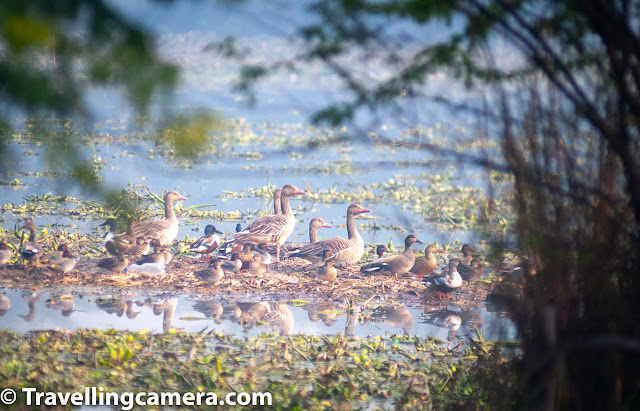
And finally we chanced upon them - the Greylag Geese. And sure enough there were hundreds of these large beautiful birds. Greylag geese are winter visitors to India. They have bluish-grey plumage with dark spots and stripes on belly and upper parts. And their legs and bill are pink. Grelag Geese often mate for life and the colonies are known to have both heterosexual as well as homosexual pairs, and both types of pairs have been observed to indulge in courtship and sexual activity.
Greylag Geese
And finally we chanced upon them - the Greylag Geese. And sure enough there were hundreds of these large beautiful birds. Greylag geese are winter visitors to India. They have bluish-grey plumage with dark spots and stripes on belly and upper parts. And their legs and bill are pink. Grelag Geese often mate for life and the colonies are known to have both heterosexual as well as homosexual pairs, and both types of pairs have been observed to indulge in courtship and sexual activity.

In the meantime, smaller waders were keeping us constant company. Now we came across the Marsh Sandpiper, which was busy foraging for food on a rock and in surrounding hyacinth. The Marsh Sandpiper feeds mostly on insects and other such small prey. It is a rather small shank with greyish brown upperparts and light belly. It has pointed dark bill and long greenish legs. It is a winter visitor in India, and is found mostly in landlocked lowlands and avoids coastal areas.
Marsh Sandpiper


In the meantime, smaller waders were keeping us constant company. Now we came across the Marsh Sandpiper, which was busy foraging for food on a rock and in surrounding hyacinth. The Marsh Sandpiper feeds mostly on insects and other such small prey. It is a rather small shank with greyish brown upperparts and light belly. It has pointed dark bill and long greenish legs. It is a winter visitor in India, and is found mostly in landlocked lowlands and avoids coastal areas. 

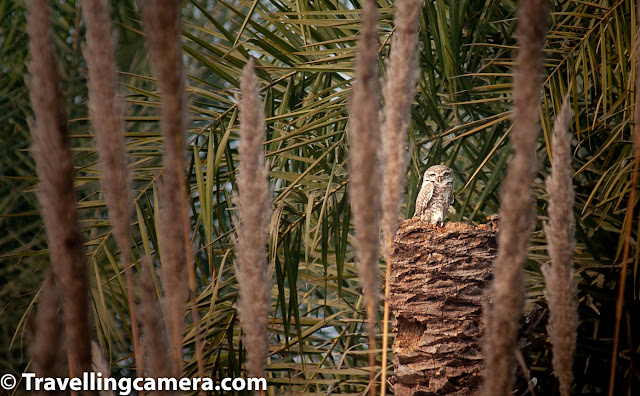
We had almost completed our round of the sanctuary, when our birder friend spotted a Spotted Owlet perched on a tree stump in broad daylight. The little owl was observing us calmly. It's head turning to track our movements. Bet it owls or owlets, they always come across as wise creatures, I don't know why "ullu" is supposed to be derogatory in Hindi. These are cute and wise creatures.
Spotted Owlet
We had almost completed our round of the sanctuary, when our birder friend spotted a Spotted Owlet perched on a tree stump in broad daylight. The little owl was observing us calmly. It's head turning to track our movements. Bet it owls or owlets, they always come across as wise creatures, I don't know why "ullu" is supposed to be derogatory in Hindi. These are cute and wise creatures.  

The spotted Owlet is a short and stocky bird with greyish-brown upperparts with white spots. It's yellow keen eyes were visible through the binoculars. The Spotted Owlet roosts during the in parties of 3-4 owls in tree cavities, leaves, or branches. They are mostly nocturnal but can sometimes be spotted during the day. They are found in farmlands and close to human settlements because of abundance of prey such as small rodents there.
Spotted Owlet
The spotted Owlet is a short and stocky bird with greyish-brown upperparts with white spots. It's yellow keen eyes were visible through the binoculars. The Spotted Owlet roosts during the in parties of 3-4 owls in tree cavities, leaves, or branches. They are mostly nocturnal but can sometimes be spotted during the day. They are found in farmlands and close to human settlements because of abundance of prey such as small rodents there. 

Just when we had started thinking that our trip was coming to an end, we chanced upon a Neelgai family. They were standing still outside the electrified fence, watching us keenly. We stopped in our tracks and just knew that even a slight movement from us, would then send them into a frenzy. However, ultimately, it wasn't us who caused the frenzy. Some Neelgais inside the park decided to take flight. They rushed through the water, crossed the track in an alarm and without giving any heed to the so-called electrified fence, broke out of the park. It was then that we realized the reason behind the breach in fences we had observed at several places. Truth is, you may want to restrain life, but it will break free. It made me strangely happy.
Neelgai (Female and babies)
Just when we had started thinking that our trip was coming to an end, we chanced upon a Neelgai family. They were standing still outside the electrified fence, watching us keenly. We stopped in our tracks and just knew that even a slight movement from us, would then send them into a frenzy. However, ultimately, it wasn't us who caused the frenzy. Some Neelgais inside the park decided to take flight. They rushed through the water, crossed the track in an alarm and without giving any heed to the so-called electrified fence, broke out of the park. It was then that we realized the reason behind the breach in fences we had observed at several places. Truth is, you may want to restrain life, but it will break free. It made me strangely happy. 

The Brown Rock Chat or Indian Chat is very similar to the Indian Robin in appearance, but is larger. It has brown upperparts and rufus-brown belly. It feeds on insects captured mostly on the ground. We spotted this bird during the last leg of our tour of the sanctuary. It was perched at a distance in the middle of the lake on a tree stump. It did not seem in a hurry to get anywhere, so VJ was able to get a good shot despite the difference.
Brown Rock Chat


The Brown Rock Chat or Indian Chat is very similar to the Indian Robin in appearance, but is larger. It has brown upperparts and rufus-brown belly. It feeds on insects captured mostly on the ground. We spotted this bird during the last leg of our tour of the sanctuary. It was perched at a distance in the middle of the lake on a tree stump. It did not seem in a hurry to get anywhere, so VJ was able to get a good shot despite the difference. 

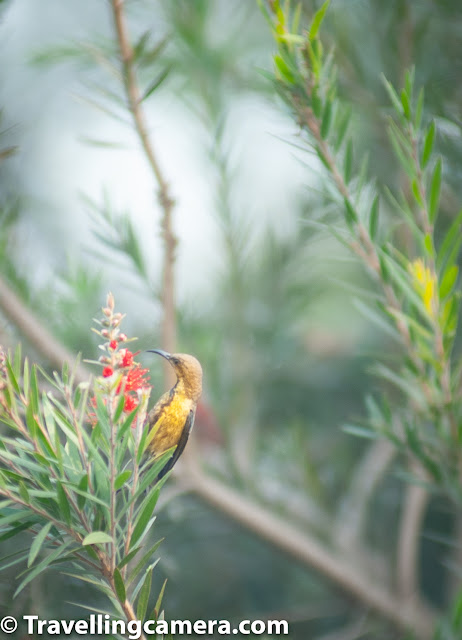
Purple Sunbird is often seen flitting around in flowering trees, bushes, and vines, and some people mistake them for hummingbirds. The truth is that there hummingbirds are very different birds and aren't found on this side of the world. Anyway, moving on to the sunbirds, the one in the above photograph doesn't look too purple. The reason is that it is a male in its non-breeding plumage. It is the breeding male that is purple. Another interesting aspect of sunbirds is that we have always found some on or close to bottlebrush trees. We established this connection first in Himachal, where a bottlebrush tree in our yard is a regular haunt of a crimson sunbird. The purple sunbird we saw in Surajpur was also flitting on a bottlebrush tree.
Purple Sunbird (Female)
Purple Sunbird is often seen flitting around in flowering trees, bushes, and vines, and some people mistake them for hummingbirds. The truth is that there hummingbirds are very different birds and aren't found on this side of the world. Anyway, moving on to the sunbirds, the one in the above photograph doesn't look too purple. The reason is that it is a male in its non-breeding plumage. It is the breeding male that is purple. Another interesting aspect of sunbirds is that we have always found some on or close to bottlebrush trees. We established this connection first in Himachal, where a bottlebrush tree in our yard is a regular haunt of a crimson sunbird. The purple sunbird we saw in Surajpur was also flitting on a bottlebrush tree. 

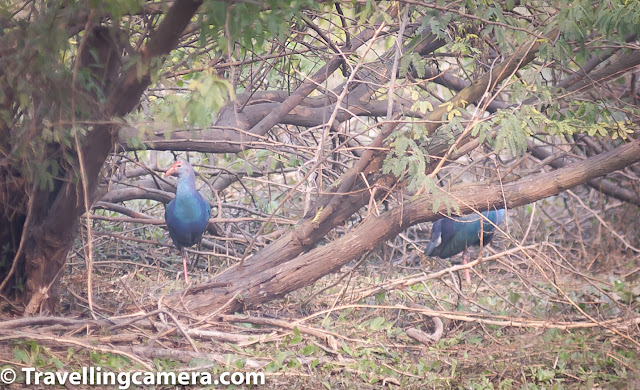
Strangely, we saw several interesting birds right before we exit the sanctuary. This pair was hiding in the bushes on the shore of the lake. Grey-headed Swamphen is a type of Rail and was earlier considered to be a subspecies of the Purple Swamphen. It was elevated to a full species status in 2015.
Grey-headed Swamphen
Strangely, we saw several interesting birds right before we exit the sanctuary. This pair was hiding in the bushes on the shore of the lake. Grey-headed Swamphen is a type of Rail and was earlier considered to be a subspecies of the Purple Swamphen. It was elevated to a full species status in 2015. 
The swamphen is a strong flier as well as swimmer and is quite eye-catching with its blackish blue plumage and an orange crown. So if a swamphen is around and you are observant, chances are that you will not have to work too hard to locate it. Photographing it is another matter altogether.
Grey-headed Swamphen
The swamphen is a strong flier as well as swimmer and is quite eye-catching with its blackish blue plumage and an orange crown. So if a swamphen is around and you are observant, chances are that you will not have to work too hard to locate it. Photographing it is another matter altogether. 

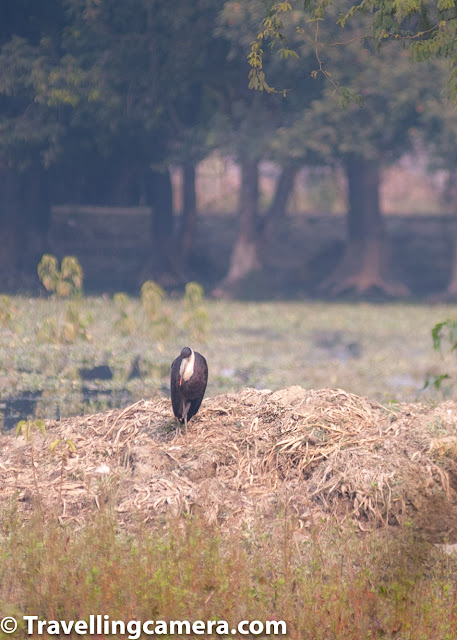
It was towards the end of our trip that we came across our old friend, the Woolly-necked Stork. The last time we had seen it was in Bharatpur, where we had seen at a distance. The bird looked quite comfortable in its solitude and I was kind of fascinated by its black wings that looked like a tux and its thick neck that looks quite woolly from the distance. Our birder friend used the beautiful analogy of a muffler to describe its neck. Those were just the words I was looking for.
Woolly-necked Stork
It was towards the end of our trip that we came across our old friend, the Woolly-necked Stork. The last time we had seen it was in Bharatpur, where we had seen at a distance. The bird looked quite comfortable in its solitude and I was kind of fascinated by its black wings that looked like a tux and its thick neck that looks quite woolly from the distance. Our birder friend used the beautiful analogy of a muffler to describe its neck. Those were just the words I was looking for. 

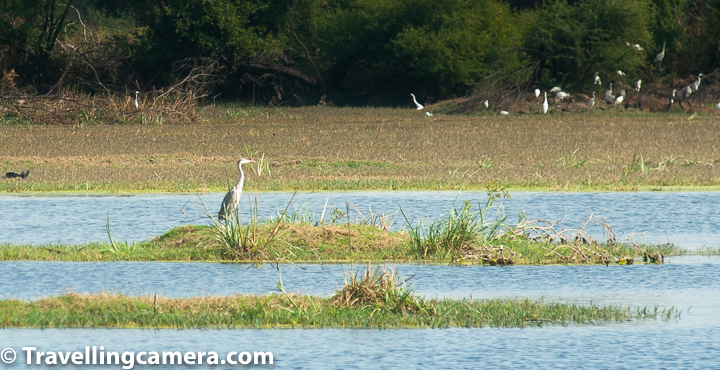
Absolutely the last bird we saw during our trip was the Great Egret. The bird was quite far away, but we could recognize it because we have seen it at multiple times in the past. Other birds we saw here were the Rufus Treepie (see part 1 of this series for photograph), Pied Bushchat, Shikra, and Indian Silverbill. The last three could not be clicked though.    By now we had spent almost three hours in the sanctuary and had seen many new birds. It had been a great day. All thanks to our birder friend, Rakesh Ranjan, who not only arranged for permissions but also guided and directed us throughout our trip. It wouldn't have been possible without him.
Great Egret
Absolutely the last bird we saw during our trip was the Great Egret. The bird was quite far away, but we could recognize it because we have seen it at multiple times in the past. Other birds we saw here were the Rufus Treepie (see part 1 of this series for photograph), Pied Bushchat, Shikra, and Indian Silverbill. The last three could not be clicked though.

By now we had spent almost three hours in the sanctuary and had seen many new birds. It had been a great day. All thanks to our birder friend, Rakesh Ranjan, who not only arranged for permissions but also guided and directed us throughout our trip. It wouldn't have been possible without him. 

Related Blogposts -

As winter approaches North India, various wetlands start seeing thousands of Migratory Birds and Bharatpur's Keoladeo Bird Sanctuary is one of the most popular wetlands around National Capital region of India and hence sees lot of tourists from Delhi/Noida/Gurgaon region. And it's not limited to nearby tourists. Lot of serious birders visit Bharatpur during Winters from various parts of the country as well as foreigner tourists. This blog-post shares tips to plan a successful trip to Bharatpur from Delhi and what kind of things to take care while planning this birding trip. One day Road-Trip to Bharatpur Birds Sanctuary from Delhi : Winters Special


We were definitely fortunate when it comes to the number of Herons and Egrets we were able to sight during our visit to the Keoladeo National Park in November. However, at that time, we did not know which was which. These two birds are so similar when it comes to their behavior that it takes an expert to identify them separately. We referred to our birding companion - A Pictorial Field Guide to Birds of India. However, I am sure we have made some mistakes in case of a few birds. In case you can spot any, please do point them out. We would be eternally grateful. Great Egrets.Both Herons and Egrets, and also the Bitterns, belong to the family Ardeidae. Though some argue that these are actually same birds with the only differences being that Egrets usually have white or buff plumage and develop distinctive white plumes during the breeding season. Otherwise, both these birds seek the same kind of habitat - wetlands. They breed in trees close to the wetlands, and they fly with their necks retracted, unlike storks and cranes who fly with their necks outstretched. Grey Heron in Flight. Experts are still undecided about what makes a heron, a heron and an egret, an egret. So much so that though these birds are classified under separate genera - Ardea and Egretta - the only marked difference in the definition of  these genera is the size. Ardea consists of larger of the Herons whereas Egretta consists of the smaller ones. Though the size difference is often indistinct. Both the birds typically have a large wingspan and look very graceful in flight. Great Egret in Flight. You will often see these birds standing still with one leg raised and their necks outstretched carefully watching out for prey to come close enough so that they can snap it up with a quick movement of their neck and beaks. These birds are carnivorous and feed mainly on fish, frogs, lizards, and molluscs. Some herons, such as the cattle egret, often move away from the wetlands and follow cattle. These egrets feed on the insects that are disturbed by the movement of cattle in bushes. Juvenile Purple Heron(?) in the foreground with Great Egrets in the Distance. Another aspect that is unique about Herons is that they have powder down. These peculiar down feathers that often disintegrate into a powdery substance are thought to be of special significance to these birds because of their wet habitat and damp surroundings. It is also believed that these birds use the powder to preen and coat the feathers that cover the rest of their body. It is supposed to protect these feathers from slime and dirt. Purple Heron. It took us a while to associate these tall, graceful birds with the little cattle egrets we are used to seeing in the city. Initially I thought that these were cranes. However, when upon further research I discovered that though cranes and herons may look alike at a glance, they are indeed two very different birds. While Herons belong to the order Pelecaniformes, Cranes are part of the Gruiformes order. Unlike Herons who hold their necks in an "S" shape and completely retract them during flight, cranes old their necks straight. Herons have longer beaks and necks than cranes, though cranes typically are bigger in size. Indian Pond Heron. We were unfortunately not able to spot any cranes during our visit to Keoladeo. Cranes that are supposed to flock in Keoladeo during winters are Siberian Crane, Sarus Crane, Demoiselle Crane, and Common Crane. Of these, Siberian Crane does not visit India any more. A single pair of these critically endangered birds was last seen in Keoladeo National Park in 2002. Since then there is no recorded sighting of these birds in India. This is sad. If you think you have seen a Siberian crane during your visit to Keoladeo National Park, you are either mistaken or unbelievably fortunate and on the verge of being famous. Grey Heron keeping company with Black-Headed and Glossy Ibises. Herons and Egrets keep company with other water birds such as ducks, coots, waterhens etc. You will often spot one or two individuals standing tall among a flock of other smaller birds. In the above photograph, a grey heron is seen peacefully existing with the much smaller ibises. The ibises in this picture are the black-necked Ibis and the Glossy Ibis, which are often mistaken as white Ibis and Black Ibis, respectively. Though the black-necked Ibis is nearly threatened, they were a common sight in Keoladeo National Park. Grey Heron up close. The dotted line running down then neck of a grey heron creates an illusion of stitch marks and you may be forgiven if you confuse the bird with a stuff toy. From a distance and also at various stages of this heron's life, it may resemble the Great Egret quite a bit. However, two of the most distinctive identifying characteristics of the Egret are its dark legs and yellow beaks, which are also almost always easily identifiable from a distance, unless the legs are hidden behind the bushes or under water. Juvenile Cinnamon Bittern. A smaller member of the Ardeidae family, the bittern is classified into a separate subfamily Botaurinae. Typically smaller than the other herons, bitterns also exhibit slightly different behavior patterns. Bitterns are smaller and plumper than a typical Heron. They also have shorter necks, though they too can retract and elongate their necks. Unlike Herons who patiently wait for their prey to wander close enough, bitterns, and also pond herons, at times are known to chase down their prey. This kind of active hunting is not seen in other Herons. The bittern seen above has a similar plumage to the Indian Pond Heron (scroll up to see), but has a cinnamon colored underbelly as opposed to a white one in the pond heron.  Grey Heron with Cattle Egret (?). In the photograph above, you can see a Grey Heron in close vicinity of a cattle egret. While structurally, both the birds seem similar, there are clear differences that can help you distinguish one from the other. While the Heron (on the left) has light-colored legs, the egret has darker, almost black, legs. Also, the beak in case of a Heron is pinkish, whereas an egret has a yellow beak. Both these birds, in the photograph above, are quite interested in something that is happening on their left. Intermediate Egret (?). This looks like a cattle egret though I cannot be sure. It's neck is too short for a great egret, though admittedly the bird looks a bit bigger than the egrets we see in the city. So may be it is an intermediate Egret. I will leave it to the experts to judge. However, such a picture of an egret standing still at the edge of water looks deceptively peaceful. I also found out what is known as the bagula in India (bagula bhagat for its unique habit of standing with one leg folded) is the same bird as the Great Egret. Purple Heron with Great Egret in the distance. Here are two of the larger birds in the same frame. The bird in the foreground is the purple heron and the one in the far distance is the great egret. You can see the thick "S" shaped neck of the Great Egret, while the purple heron up close has a slender neck, though this bird too can retract its neck when it so feels like. We were really grateful to spot these graceful birds in their natural habitat. The Keoladeo National Park is one of the very few walled wetlands where migratory and resident birds are safe from human interference. Cattle Egret. The sheer variety of birds at Keoladeo National Park is overwhelming. More than 400 different species have been observed here. Of those, we were only able to see a handful. At the time, we thought some of these herons and egrets and storks were migratory, but it turns out that they are all resident. The only migratory birds we saw were the smaller ones. The park is already lively, and I wonder how much more lively it would be once the migratory birds arrive. Anyhow, I think February would be a good time for another visit.
Juvenile Purple Heron(?) in the foreground with Great Egrets in the Distance

Herons and Egrets at Keoladeo National Park || Waterbirds and Waders at Bharatpur


Comments

Rakesh Ranjan said…
Wow, Vibha what a lovely write up, I almost did the trip again while reading. Spotted Owl was the most exciting sighting, all these days I was hoping to see one.
Rakesh Ranjan said…
Wow Vibha, what a lovely write up. I almost did the trip again while reading this.

Trending Post Today !

How to reach Kasol/Malana and top things to do around this stunning hill-station of Himalayan State of India

Main places to see & Top things to do around Dalhousie : Stunning Hill Station in Himalayan State of India