

Introduction: When Kolkata Stops Being an Ordinary City
There are festivals you attend, and then there are festivals that seem to take over the city.
Durga Puja in India reaches another level in Kolkata. For a few extraordinary days, the city does not merely celebrate Durga Puja; it seems to reorganise its entire rhythm around it. Streets become pedestrian corridors, neighbourhoods compete through art and imagination, old mansions open their courtyards, food stalls stay busy late into the night, and people who might otherwise never meet end up standing shoulder to shoulder in front of a beautifully crafted idol.
And then there is the sound.
Dhak begins somewhere in the distance. A conch shell cuts through the traffic. Someone is laughing beside you. A child is staring at an enormous pandal. A photographer is crouched on the pavement waiting for the right frame. Somewhere inside, a priest is chanting.
Kolkata during Puja is sensory overload, but strangely, it rarely feels chaotic in the emotional sense. There is a collective anticipation that is difficult to explain until you have walked through the city yourself.
UNESCO recognised Durga Puja in Kolkata as Intangible Cultural Heritage of Humanity in 2021, describing it as a remarkable combination of religion, art, installations, music, community participation and craftsmanship.
That description is accurate. But it still doesn't quite prepare you for what it feels like to be there.

Why Visit Kolkata for Durga Puja?
If you have seen photographs of Kolkata's Durga Puja, you might assume the attraction is simply the spectacular pandals.
It isn't.
The real attraction is the contrast.
One evening you may stand beneath an enormous contemporary installation created from bamboo, fabric, metal, paper or recycled materials. The next morning you could be inside a centuries-old family courtyard watching rituals that have barely changed in generations.
You can move from Kumartuli's clay-filled workshops to Shobhabazar's old aristocratic houses, from a neighbourhood bhog meal to a late-night kathi roll, and from a quiet morning beside the Hooghly to streets filled with people after dark.
This is what makes Kolkata particularly fascinating for photographers and culturally curious travellers.
You are not photographing a single festival.
You are photographing a city revealing itself.
The Cultural Significance of Durga Puja in Kolkata
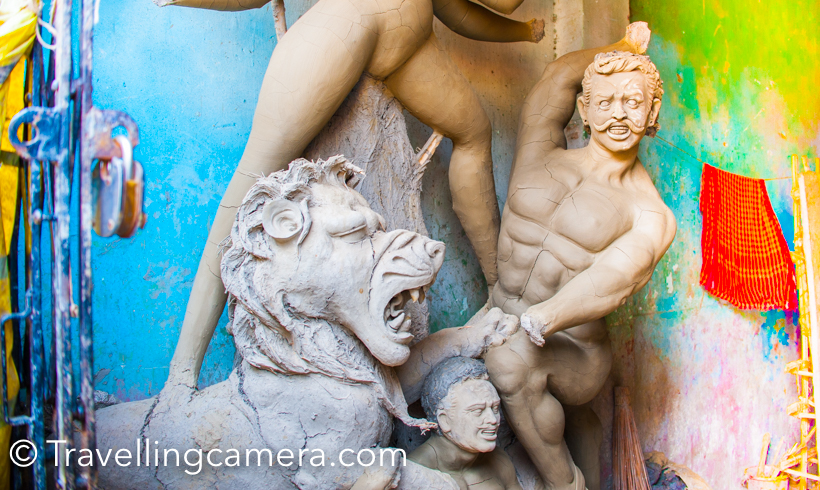
At its heart, Durga Puja celebrates Goddess Durga's victory over Mahishasura. But the Bengali interpretation adds another deeply human dimension.
Durga is also Uma, the daughter returning to her maternal home.
That idea of homecoming is everywhere.
Families reunite. Friends return to Kolkata. People living abroad plan their annual visits around Puja. New clothes are bought. Homes are cleaned. Food is prepared. Old family rituals are revived.
The festival therefore becomes simultaneously religious, social, artistic and intensely personal.
UNESCO's description of the tradition notes something particularly interesting: artisans create the clay images using unfired clay, traditionally sourced from the Ganga, and after the festival the images return to water through immersion.
There is a beautiful circularity here.

Earth becomes goddess. Goddess returns to water.
For a photographer, this also creates a fascinating visual narrative: raw clay in Kumartuli, an unfinished face, painted eyes, the completed idol inside a pandal and finally the immersion procession.

A Brief History: From Zamindar Houses to Community Puja
The history of Durga Puja in Kolkata is closely connected with the city's transformation.
Some of the oldest celebrations were associated with wealthy Bengali families and aristocratic households.
One of the most famous examples is Shobhabazar Rajbari.
Raja Nabakrishna Deb began the celebrated Shobhabazar Rajbari Puja in 1757, shortly after the Battle of Plassey. Historical accounts describe British officials including Robert Clive and Warren Hastings being invited to the festivities.
That history gives the Puja an unusual layer. It was not simply a religious celebration; it also became a stage where wealth, social influence and political relationships were displayed.
Over time, however, Durga Puja moved beyond elite households.
The rise of barowari or community Puja transformed the festival into something much more public. Instead of being primarily a family affair, Puja became something an entire neighbourhood could organise, fund and celebrate together.
That transition eventually produced the Kolkata we see today: thousands of community celebrations ranging from intimate neighbourhood pujas to enormous artistic productions.

Durga Puja in India: Kolkata's Pandal Culture
The word "pandal" hardly captures what these structures can become.
Some are temporary temples.
Some resemble museums.
Others imitate famous buildings, villages, landscapes, historical structures or completely imagined worlds.
And then there are those that are deliberately difficult to categorise.
The remarkable part is that the pandal is temporary.
A structure that may take months to conceptualise and build can disappear within days.
That impermanence is one reason I find Kolkata's Puja particularly compelling from a photographic perspective.
You know that the scene exists only briefly.
You therefore photograph it differently.
North Kolkata: Where History Still Lives in the Streets
If you want to understand the older personality of Kolkata's Puja, start in North Kolkata.
The architecture itself becomes part of the experience.
Look beyond the pandals and notice:
- old balconies
- colonial-era buildings
- narrow lanes
- crumbling facades
- courtyards
- old signboards
- electrical wires crossing overhead
- families watching the procession from balconies
Shobhabazar Rajbari
The Rajbari is one of the essential stops for understanding Bonedi Bari Durga Puja.
Its central Nat Mandap creates a very different visual experience from a modern theme pandal. The architecture, pillars and courtyard provide natural framing opportunities.
Don't rush.
Look at the people rather than just the idol.
A grandmother sitting quietly in one corner may tell you more about the continuity of the tradition than a perfectly symmetrical photograph of the Durga idol.

Kumartuli
Then walk towards Kumartuli.
This is where Kolkata's famous clay-idol tradition becomes visible.
Workshops are cramped, intimate spaces. Clay, straw, bamboo frameworks, paint and unfinished figures coexist in surprisingly small rooms. Incredible India describes Kumartuli as a historic potters' quarter on the Hooghly, where artisans create idols for Kolkata and beyond.
The most interesting photographs here are rarely the finished idols.
Look for the in-between stage.
A hand without paint.
A face waiting for eyes.
A row of heads.
A craftsman applying colour.
Sunlight entering through a small workshop opening.
These photographs tell the story behind the festival.

South Kolkata: Contemporary Durga Puja as Public Art
Move south and the character changes.
Large community pujas increasingly experiment with themes, architecture, lighting and immersive experiences.
Popular areas include:
- Gariahat
- Ballygunge
- Ekdalia
- New Alipore
- Chetla
- Mudiali
- Behala
Several major pujas have become destinations in themselves, with College Square, Ekdalia Evergreen, Santosh Mitra Square, Suruchi Sangha and others regularly attracting enormous crowds.
But here's a useful travel observation:

Don't build your entire trip around a list of famous pandals.
You will spend too much time travelling between crowds and too little time actually experiencing Kolkata.
Choose a few major destinations and deliberately leave space for smaller neighbourhood pujas.
Sometimes the small pandal with twenty people around it gives you a better photograph than the famous one surrounded by thousands.

College Square: A Photographer's Playground
College Square is particularly interesting after sunset because the illuminated surroundings can reflect in the water.
The composition almost creates itself:
idol + lights + lake + reflections + people.
Arrive before complete darkness if you want to photograph the transition from blue hour into night.
The blue sky still has some colour, while the artificial lights begin to dominate the scene.
Use a slower shutter speed if crowds allow it.
A reflection photograph at blue hour can often look more atmospheric than a completely dark frame.
Durga Puja Worldwide: How Kolkata's Festival Travels
The phrase Durga Puja Worldwide is not merely a search keyword.
It reflects a genuine phenomenon.
Bengali communities across India and around the world celebrate Durga Puja, carrying elements of Kolkata's cultural traditions into new cities.
But something fascinating happens when the festival travels.
The ritual remains recognisable while the surroundings change.
A community in London, New York, Singapore or Dubai may recreate aspects of Bengali food, music, worship and social gatherings, but the experience naturally adapts to the local environment.
Kolkata remains special because the festival is not contained inside one venue.
The city itself becomes the venue.
Bonedi Bari Puja: The Other Kolkata You Should Not Miss
If modern pandals are the spectacular face of Durga Puja, Bonedi Bari Puja is its memory.
These are traditional family celebrations held in historic homes.
The rituals can differ significantly from one household to another.
Some have distinctive idol designs. Others follow particular food traditions or ritual sequences.
Recent accounts of Kolkata's old family pujas illustrate just how varied these traditions can be. For example, the Mallik Bari Puja in North Kolkata has a particularly unusual representation of Durga, while other historic families retain their own distinctive rituals and food traditions.
This is why I would recommend experiencing both.
One modern theme Puja. One old family Puja.
Together they explain Kolkata much better than either one alone.
The Best Photography Experiences During Durga Puja in India
For photographers, Kolkata during Puja is almost unfairly generous.
There is something happening everywhere.
But the biggest mistake is photographing only the idols.
Try building a visual story.
Photograph the preparation
Visit Kumartuli before the main festival.
Photograph:
- clay
- straw
- hands
- faces
- paint
- tools
- unfinished idols
Photograph people
The strongest Puja photographs often contain no goddess at all.
Look for:
- elderly people watching rituals
- children seeing a pandal for the first time
- dhakis
- volunteers controlling queues
- street vendors
- women preparing offerings
- families eating bhog
- photographers waiting patiently
Photograph the city
Kolkata itself becomes part of the composition.
Try:
old architecture + modern lights
tram/bus + Puja decoration
crowd + illuminated pandal
street vendor + festive lights
balcony + people below
dhak player + blurred crowd
These contrasts make your photographs feel like Kolkata rather than generic festival photographs.
Best Photography Spots and Times
| Location/Experience | Best Time | What to Photograph |
|---|---|---|
| Kumartuli | Morning | Artisans, clay idols, workshops |
| Shobhabazar Rajbari | Morning/ritual timings | Architecture, rituals, people |
| College Square | Blue hour to evening | Reflections and illuminated pandal |
| North Kolkata lanes | Early morning | Quiet streets and architecture |
| Major theme pandals | Late afternoon + night | Exterior architecture and crowds |
| Dhunuchi dance | Evening | Movement, smoke and expressions |
| Immersion ghats | Late afternoon/evening | Processions and emotional moments |
| Neighbourhood pujas | Morning | Local community life |
A useful photography trick
Don't arrive at every pandal at 9 pm.
The light may be spectacular, but the crowd can make photography extremely difficult.
Instead, photograph the architecture during late afternoon, return after dark for atmosphere, and then move on.
This two-stage approach gives you two completely different photographs of the same place.
Photography Tips for Kolkata Durga Puja
Carry a small camera setup
A 24–70mm equivalent zoom is extremely versatile.
Add a 70–200mm if you enjoy candid portraits from a respectful distance.
A fast prime around 35mm or 50mm is excellent for people and low-light storytelling.
Watch your shutter speed
Dhak players move quickly.
Try around 1/250 sec or faster for sharp action.
For deliberate motion blur, experiment around 1/15–1/30 sec.
Don't overuse wide-angle lenses
A huge pandal can tempt you into using the widest lens you own.
But wide-angle photographs can become visually empty.
Sometimes a tighter frame of a doorway, decorative detail or person standing beneath the structure tells a stronger story.
Protect your equipment
October in Kolkata can still be humid, and evening showers are possible.
Carry:
- rain cover
- microfiber cloth
- spare batteries
- memory cards
- power bank
- small towel
- comfortable camera strap
And don't carry more equipment than you need.
You will walk much more than you expect.

Food: Kolkata's Puja Is Also a Culinary Journey
You cannot understand Puja without food.
One of the most recognisable experiences is bhog.
A typical community Puja bhog may include khichuri, labra, chutney and payesh, although menus vary considerably between households and puja committees.
There is something wonderful about eating bhog in a crowded community space.
It isn't fine dining.
It isn't supposed to be.
You sit, stand or queue with strangers, receive food and eat together.
Then there is the food outside the pandal.
During an evening of pandal hopping, look for:
- phuchka
- kathi rolls
- egg rolls
- fish fry
- chops
- telebhaja
- biryani
- mishti
- sandesh
- rosogolla
- payesh
And leave room for spontaneous discoveries.
One of the joys of Puja is that food becomes part of the route rather than a separate activity.
Human Stories: Look Beyond the Pandal
Spend a few minutes talking to people.
Ask a volunteer how long their Puja has existed.
Ask a dhaki where they travelled from.
Ask an artisan how long it took to create an idol.
Ask a shopkeeper what Puja means for their business.
You will quickly discover that there isn't one Durga Puja.
There are thousands.
For one family, it means returning home after a year away.
For an artisan, it may mean months of intense work.
For a child, it may mean new clothes and late nights.
For a photographer, it may mean an annual pilgrimage.
For a neighbourhood, it can be the one period of the year when everyone participates.
These conversations are often more memorable than another photograph of a spectacular pandal.
Lesser-Known Experiences Around Kolkata Durga Puja
1. Go to Kumartuli before the crowds
Don't wait for the festival.
The preparation period reveals the craftsmanship much better.
2. Explore old North Kolkata lanes
Instead of jumping between famous pandals, walk slowly through neighbourhoods around Shobhabazar, Bagbazar and Kumartuli.
Look upward.
Some of the best details are on balconies and old facades.
3. Watch the volunteers
Puja requires enormous behind-the-scenes coordination.
Volunteers are constantly managing queues, footwear, movement and crowd flow.
They are an overlooked part of the festival story.
4. Visit a smaller neighbourhood Puja
Ask your hotel host, driver or local friend which local Puja they visit themselves.
That answer can be more valuable than an internet ranking.
5. Experience immersion
Dashami changes the mood completely.
The celebration becomes emotional.
The goddess who arrived with such fanfare is now leaving.
Best Time to Visit Kolkata for Durga Puja
The festival normally falls in September or October, depending on the lunar calendar.
For 2026, the West Bengal government's Puja permission portal lists Mahalaya on 10 October, with the main Puja period running from 17 October to 21 October, culminating in Vijaya Dashami.
The precise ritual timings can differ according to the panjika followed by individual pujas, so check the schedule of the specific Puja you intend to photograph.
Which day should you choose?
If you are visiting for photography, I would ideally spend at least three full days.
How to Reach Kolkata
Kolkata is well connected by air, rail and road.
By air
Netaji Subhas Chandra Bose International Airport is the primary airport serving the city.
By train
Howrah and Sealdah are the two major railway gateways.
For Puja, book trains well in advance.
Getting around during Puja
This is where planning becomes important.
Don't assume you can simply take a taxi from one famous pandal to another.
During Puja, traffic restrictions, diversions and pedestrian-only stretches can dramatically change travel times. Kolkata Police's 2026 arrangements include road closures, one-way systems and restrictions around major Puja zones.
Metro + walking is often a much more practical strategy than depending on cars.
Where to Stay
For first-time visitors, choose your accommodation based on the type of Puja experience you want.
| Area | Best For |
|---|---|
| Central Kolkata | Balanced access to multiple areas |
| Esplanade | Transport connectivity |
| Park Street | Food, nightlife and central location |
| North Kolkata | Heritage and traditional Puja |
| Ballygunge/Gariahat | South Kolkata pandal hopping |
| New Town/Salt Lake | Modern hotels and newer areas |
My preference for a photography-focused trip would be somewhere with good metro access rather than choosing a hotel simply because it looks luxurious.
During Puja, location beats luxury.
Budget Tips for Durga Puja
Kolkata can be surprisingly affordable during Puja if you plan intelligently.
Save money by:
- using the metro
- walking between nearby pandals
- eating bhog
- choosing local eateries
- staying near public transport
- avoiding unnecessary taxis
- travelling with a refillable water bottle
- carrying snacks during long walks
The biggest hidden expense is often not accommodation or food.
It is time lost in traffic.
A ₹300 taxi ride that takes two hours is far less useful than a short metro ride followed by a walk.
A Practical 3-Day Durga Puja Itinerary
Day 1: North Kolkata and Heritage
Morning
Kumartuli → old North Kolkata lanes → Shobhabazar
Spend time photographing artisans and architecture.
Afternoon
Rest and have lunch.
Evening
Explore Bagbazar and nearby neighbourhood pujas.
Finish with dinner and street food.
Day 2: Central and South Kolkata
Morning
Start slowly.
Visit one traditional family Puja or heritage area.
Late afternoon
Move towards central Kolkata.
College Square around blue hour can be particularly rewarding for photography.
Night
Continue towards major central pandals.
Don't try to see ten.
See three properly.
Day 3: South Kolkata + People + Food
Morning
Explore a quieter neighbourhood Puja.
Afternoon
Take a break.
Evening
Explore Gariahat, Ballygunge, Ekdalia or nearby Puja zones.
Spend time photographing people rather than only installations.
End with a proper Bengali meal.
Responsible Travel During Durga Puja
The crowds can be overwhelming, but remember that this is a religious festival before it is a photography opportunity.
A few simple rules make a big difference.
- Ask before photographing people closely.
- Don't block ritual spaces for a photograph.
- Follow volunteer instructions.
- Don't enter restricted areas.
- Avoid touching idols or decorations.
- Dress comfortably and respectfully.
- Don't use flash during rituals unless permitted.
- Don't push into queues for a better photograph.
- Carry your waste with you.
- Avoid disposable plastic where possible.
- Be particularly careful around children and elderly people in dense crowds.
The best travel photograph is never worth making someone uncomfortable.
Common Mistakes to Avoid
Trying to see everything
You can't.
Kolkata has too many Puja celebrations.
Pick a region and explore deeply.
Only visiting famous pandals
You may end up seeing spectacular installations without seeing much of Kolkata.
Going everywhere at peak night hours
The atmosphere is incredible, but photography becomes difficult.
Carrying too much camera gear
You will regret the heavy backpack halfway through the night.
Ignoring traditional Puja
Modern pandals are visually spectacular, but Bonedi Bari Puja gives you a completely different understanding of the festival.
Forgetting to eat
Pandal hopping can involve kilometres of walking.
Keep yourself hydrated and eat regularly.
Treating the festival like a photo safari
Pause occasionally.
Watch the ritual.
Listen to the dhak.
Eat the bhog.
Talk to someone.
Then take the photograph.
FAQs About Durga Puja in Kolkata
What is the best place to experience Durga Puja in India?
Kolkata is one of the most immersive places to experience Durga Puja because the celebration combines community worship, temporary architecture, traditional family rituals, food, music and public art across the entire city.
When is Durga Puja in Kolkata?
Durga Puja normally takes place in September or October. In 2026, the West Bengal government's SAHAJ portal lists the main festival from October 17 to October 21, with Mahalaya on October 10.
How many days should I spend in Kolkata during Durga Puja?
Three full days is a good starting point. Four or five days allows you to combine major pandals, traditional family pujas, Kumartuli, food experiences and immersion.
What is the difference between a pandal and a Bonedi Bari Puja?
A pandal is a temporary structure created for a community Puja. Bonedi Bari Puja takes place in historic family homes and often follows distinctive traditions passed through generations.
Is Kolkata Durga Puja good for photography?
Absolutely. It offers architecture, portraits, street photography, low-light scenes, rituals, food, craftsmanship, movement and documentary storytelling within a very small geographic area.
What is the best time to photograph Durga Puja pandals?
Late afternoon and blue hour are particularly useful because you can photograph the structure in natural light before returning after dark for illumination and crowd atmosphere.
Where can I see Durga idols being made in Kolkata?
Kumartuli is the city's famous traditional potters' quarter and one of the best places to observe the craftsmanship behind Durga Puja.
What food should I try during Durga Puja?
Start with bhog khichuri and labra, then explore Kolkata's street food such as phuchka, kathi rolls, chops and sweets. Food traditions vary considerably between different pujas and households.
Is Durga Puja celebrated outside India?
Yes. Bengali communities around the world celebrate Durga Puja, although the scale and form naturally vary according to the local community and location. UNESCO notes that the festival is celebrated both elsewhere in India and among the Bengali diaspora.
What makes Kolkata Durga Puja different?
The most distinctive feature is that the festival becomes a city-wide cultural experience. Religion, art, temporary architecture, food, music, neighbourhood life and public participation all happen simultaneously.
Final Thoughts: Don't Just See Kolkata During Puja. Walk Through It.
The first time you encounter Kolkata during Durga Puja, it is tempting to chase the spectacle.
The biggest pandal.
The tallest idol.
The most elaborate lights.
The famous names.
But after spending enough time here, the spectacle begins to feel almost secondary.
The real magic is in the smaller moments.
A craftsman's hand covered in clay.
An old woman watching the evening rituals from a balcony.
A child standing speechless in front of an enormous idol.
A dhaki playing with his eyes closed.
A family eating bhog together.
A volunteer helping an elderly visitor through a crowd.
A narrow lane suddenly glowing under hundreds of lights.
And finally, the strange silence that arrives after the noise, when the goddess is carried towards the river for immersion.
That is what makes Durga Puja in India, and particularly in Kolkata, so much more than a festival.
It is a temporary transformation of a city.
For a few days every year, Kolkata becomes an enormous open-air gallery, temple, dining room, theatre and family home.
And perhaps that is the best way to photograph it too.
Don't photograph only what everyone came to see.
Photograph what happens around it.
That is where the real Kolkata is.
Related Blogposts -





.jpg)
Comments