
Demoiselle cranes of Khichan, Jodhpur District, Rajasthan || Beautiful Birds that fly to and fro Mangolia and have found a mention in Indian mythological texts

Demoiselle Cranes (grus virgo) are a species of crane that breed in central Eurosiberia, ranging from Black Sea and Mangolia to North Eastern China, plus a small breeding population in Turkey. The birds fly south to Africa and Indian subcontinent to spend the winter months.

At 76 cm tall, Demoiselles are the smallest birds in the crane family. They are also tall and slender and delicate looking birds that often symbolise beauty and fragility. They are predominantly gray in color with black neck and head and a white stripe running from their eyes all the way to the back of their head.

The birds fly in a V formation, like most other birds that are used to migrating over large distances. The V formation is headed by a female with two sub-adults flying on either side of her and the males make up the rear of the formation.

Demoiselle cranes take a very hard migratory path each way. They fly at a really high altitude at about 16,000 - 26,000 feet. They cross the Himalayas twice every year and many die because of hunger, starvations, tiredness, or fall prey to predators like the Golden Eagle.

The birds are known as koonj or kurjan in North Indian languages. In Sanskrit, the birds are known as kranch. In fact it is the demoiselle crane that is credited with being the source of inspiration for the first metered verse. As per Indian mythology, when Valmiki witnessed the lament of a female demoiselle crane whose mate had been killed by a hunter, he cursed the hunter in a verse that spontaneously came to him.

There is also a mention of kraunch in Mahabharat. On the second day of the Kurukshetra war, it is written in some texts that both the sides arranged their troops in kraunch formation. It was thought to be an effective troop formation.

The demoiselle crane was so named by Queen Marie Antoinette for its delicate and maiden-like appearance. Demoiselle crane's local names in Urdu (Koonj) and in Pashto (Zaanray) both mean a beautiful person. And the crane is marked Least Concern in the IUCN Red List of Threatened Species.
Related Blogposts -






Related Blogposts -
 One day Road-Trip to Bharatpur Birds Sanctuary from Delhi : Winters Special


 Travel Guide for weekend trip from Delhi to Taj Mahal, Fatehpur Sikri and Bharatpur Bird Sanctuary
 |
| Adult Egyptian Vulture - the Indian subspecies |
Birds of Prey at Keoladeo National Park || Watchful Eyes that Track your Every Movement

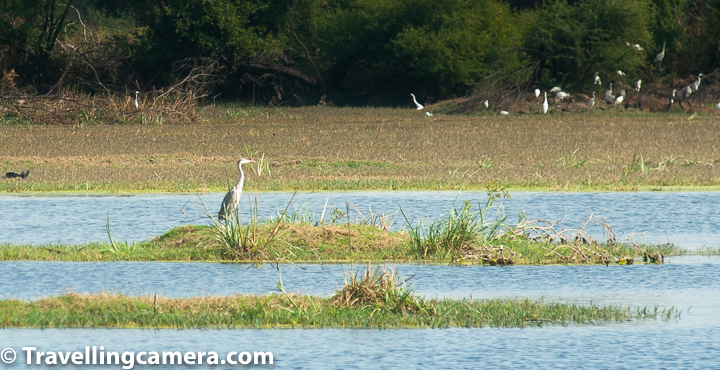 |
| Juvenile Purple Heron(?) in the foreground with Great Egrets in the Distance |
Herons and Egrets at Keoladeo National Park || Waterbirds and Waders at Bharatpur
 |
Lesser Whistling Duck |
Smaller Waterbirds at Bharatpur || Birds of Keoladeo National Park


 |
| Blue-throated Barbet |


.jpg)
Comments